Quick Summary
Clear raincoats are transparent or semi-transparent waterproof garments used for commuting, outdoor events, tourism, schools, promotional campaigns, and retail rainwear collections. The best material depends on the target market: PE works for low-cost event rainwear, EVA suits lightweight reusable use, PVC offers stronger structure and waterproof performance, while TPU is better for premium transparent rainwear. For wholesale buyers, the key is not only transparency, but also material safety, odor control, waterproof construction, packaging, logo printing, and compliance expectations.
Best Uses for Clear Raincoats
Daily commuting
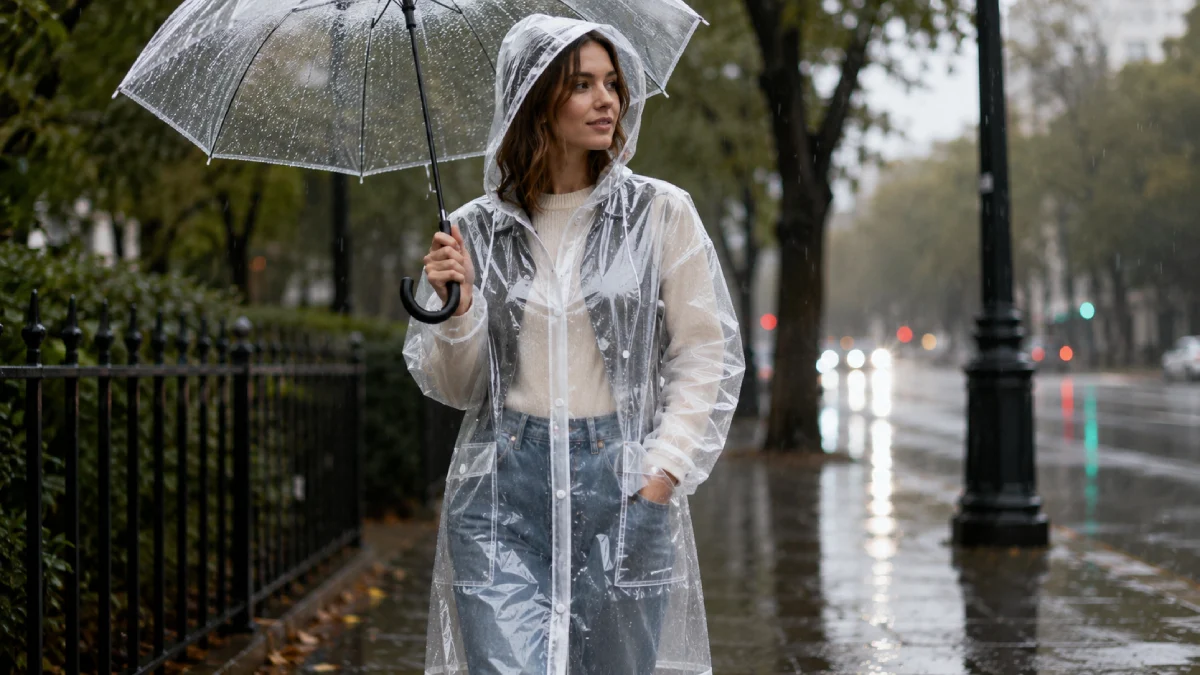
Clear raincoats are suitable for daily commuting because they offer practical rain protection without creating a heavy or overly technical look. For city users, the appeal is simple: they can wear a transparent raincoat over office clothing, casual outfits, or school uniforms without hiding the original style. This makes clear raincoats especially useful for urban markets where function and appearance both matter.
For commuters, the ideal product should be lightweight, easy to fold, comfortable around the hood and shoulders, and simple to open or close. A full-length transparent raincoat may protect more of the body, while a shorter clear rain jacket may feel easier for cycling, public transport, or walking between buildings. The best option depends on the climate, user habits, and how long the garment is usually worn.
Buyers targeting commuter markets should avoid very thin disposable materials unless the product is clearly positioned as emergency rainwear. A daily commuting raincoat should feel reusable, stable, and comfortable enough for repeated wearing. If the material feels too sticky, noisy, or stiff, the user may keep it in the bag and never wear it again. That is not a product; that is a folded complaint waiting for rain.
Outdoor events and festivals
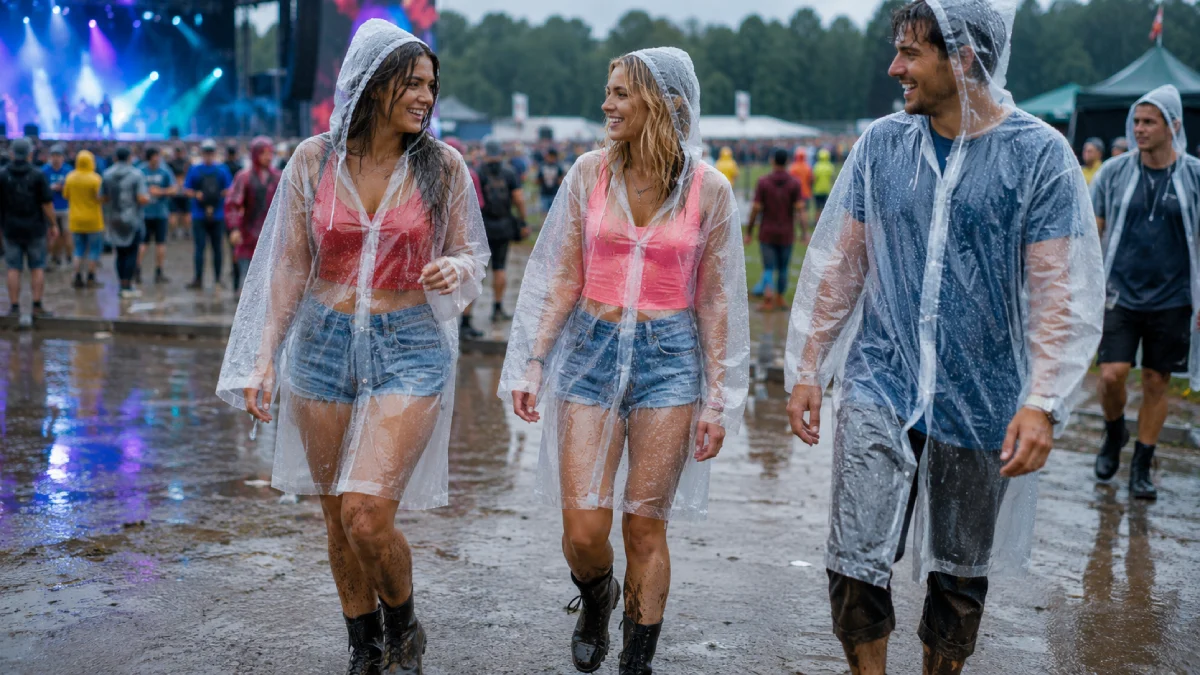
Outdoor events are one of the strongest use cases for transparent rainwear. Music festivals, sports events, open-air markets, school activities, charity walks, and public gatherings often need fast rain protection for many people. In these situations, clear raincoats or transparent ponchos help protect visitors without covering event clothing, team colors, staff uniforms, or promotional shirts.
For event use, the product should be easy to pack, easy to distribute, and simple to wear. PE or lightweight EVA may be suitable when the product is used for short periods. If the event brand wants a better user experience, thicker EVA or a more refined transparent raincoat may be worth considering.
Branding is also important for event buyers. A logo printed on the chest, back, or packaging can turn rainwear into a useful promotional item. However, buyers should test printing before mass production. Transparent materials can behave differently under ink, heat transfer, folding, and moisture exposure. A logo that looks sharp on a flat sample may crack or peel after the garment is packed and opened.
Theme parks and tourism
Theme parks, scenic areas, resorts, zoos, museums, and tourist attractions often sell or provide rainwear during sudden weather changes. Clear waterproof raincoat products work well in these settings because they are easy to understand and visually neutral. Tourists may not want a dark or heavy raincoat that hides their clothing in photos. A transparent raincoat allows them to stay protected while keeping the travel experience visually light.
For tourism channels, packaging and display are important. The raincoat may be purchased quickly near an entrance, gift shop, hotel desk, or attraction store. The packaging should clearly show size, material, style, and use. If the product is too tightly packed, fold marks may reduce the perceived value. If the packaging is too bulky, it may not fit well in retail displays or travel bags.
Tourism buyers should also consider size flexibility. A one-size transparent poncho may be easier for emergency sales, while a clear raincoat with multiple sizes may create a better wearing experience. The right choice depends on whether the buyer prioritizes convenience or product value.
Kids rainwear
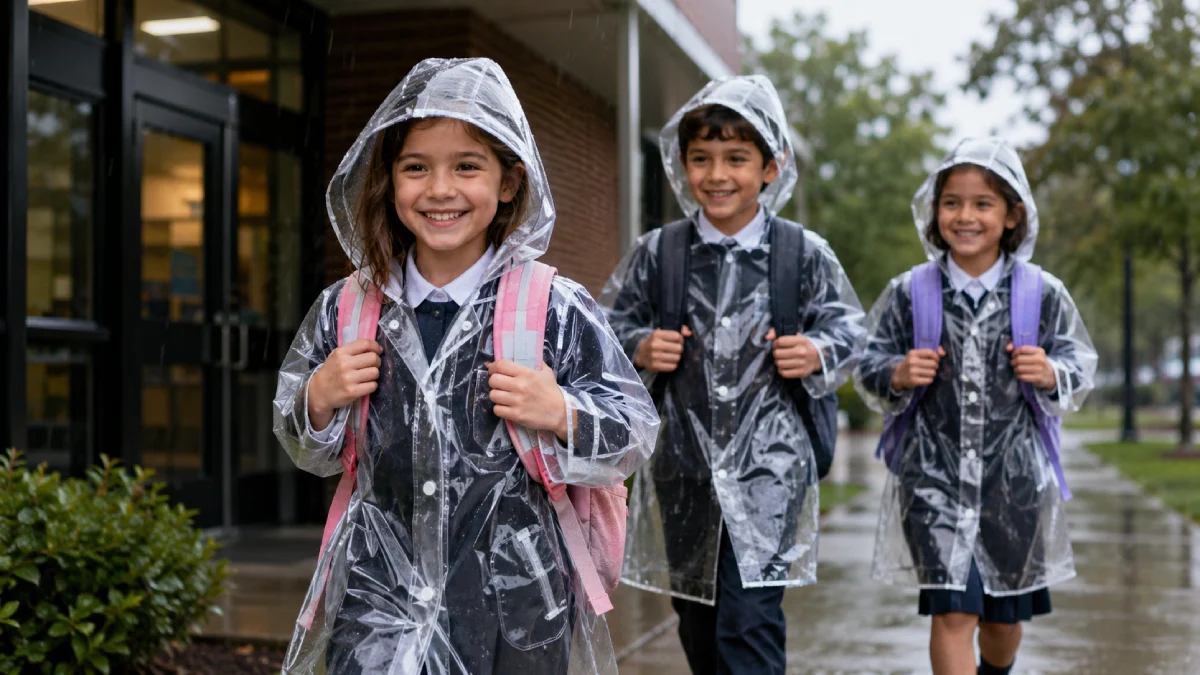
Clear raincoats can be attractive for children’s rainwear because they allow colorful clothing, school uniforms, and reflective details to remain visible. Parents and teachers may also find it easier to identify children in groups when the rainwear does not fully hide their clothing.
However, children’s rainwear requires extra care. The product should not only look cute. It should be soft, comfortable, easy to wear, and designed with safe details. Hood shape, neck opening, snap strength, sleeve length, garment length, and material flexibility all matter. A stiff raincoat may look fine in a product photo but feel uncomfortable for a child during real use.
For children’s products, buyers should pay more attention to material safety, odor control, drawstring design, small parts, labeling, and market-specific requirements. If the product is intended for schools, retail chains, or children’s brands, the supplier should be able to discuss sample testing and documentation. This is not the place to gamble with the cheapest unknown material.
Promotional rainwear
Promotional rainwear needs to balance cost, logo visibility, packing efficiency, and user experience. Clear raincoats can work well because they provide a clean visual base for branding while still allowing the user’s clothing to show. This is useful for sports campaigns, public events, outdoor advertising, charity activities, and corporate gifts.
For promotional buyers, the product does not always need to be premium, but it should still be reliable enough to protect the brand image. If the raincoat tears too easily or has a strong odor, users will remember the brand for the wrong reason. That is not marketing; that is weatherproof embarrassment.
The best promotional clear raincoat depends on the campaign goal. For one-day events, PE or EVA may be enough. For brand gifts, travel kits, or repeated use, EVA, TPU, or better-grade PVC may be more suitable. Buyers should also confirm packaging style, logo size, printing method, carton quantity, and delivery schedule before production.
Retail fashion rainwear
For retail fashion, clear raincoats need better appearance, cleaner finishing, softer touch, and more thoughtful packaging. Consumers buying retail rainwear expect more than basic rain coverage. They expect the product to look good, feel acceptable, and match their daily clothing.
A transparent raincoat for retail may include details such as colored trim, contrast buttons, adjustable hood, clean snap closures, pockets, printed pouch, or subtle logo placement. A frosted or tinted finish may also create a more premium look than fully clear plastic.
Retail buyers should pay close attention to yellowing, scratches, odor, fold marks, and size grading. These problems are especially visible in transparent rainwear. A small quality issue that might be hidden on an opaque fabric can become obvious on a clear surface.
Pet raincoats
Pet raincoats can also use clear materials because the transparent look keeps the animal’s natural color visible while providing rain protection. This market is different from adult rainwear, but it shares similar concerns: material softness, odor, flexibility, closure comfort, and packaging.
For buyers mainly focused on human rainwear, pet raincoats can be treated as an additional product line rather than the main direction. It may be useful for lifestyle brands, pet stores, and promotional collections, but it should not distract from the main clear raincoat category unless the buyer already serves pet product channels.
How Regulations Are Changing Clear Raincoat Sourcing
REACH and phthalate control for plasticized materials
Regulations are changing how buyers evaluate rainwear materials, especially plasticized products. For transparent raincoats made from PVC or other flexible plastic materials, buyers should pay attention to phthalate-related restrictions in target markets. The European Union’s REACH framework restricts certain phthalates in many consumer products, and buyers selling into Europe should not ignore this topic.
This does not mean every PVC clear raincoat is unsafe. It means the buyer should request appropriate material information from the supplier and confirm whether the product is suitable for the intended market. The risk is higher when the product is designed for children, close skin contact, retail brands, or regulated sales channels.
A professional buyer should ask for material composition, available test reports, intended market experience, and whether alternative materials such as EVA or TPU may be more suitable. Compliance should be discussed before sampling, not after bulk production. Once thousands of raincoats are packed in cartons, it is a little late to discover that the material does not meet the buyer’s market requirements.
CPSIA considerations for children’s rainwear
For children’s rainwear sold in the United States, buyers should pay attention to product safety requirements. The U.S. Consumer Product Safety Commission restricts certain phthalates in children’s toys and child care articles, and children’s products are generally held to higher safety expectations. Depending on product classification, design, and sales channel, additional requirements may apply.
For children’s clear raincoats, buyers should consider material safety, odor, small parts, drawstrings, sharp edges, labels, and packaging warnings. A children’s raincoat is not just a smaller adult raincoat. It must be designed for movement, comfort, safety, and easy wearing.
If the buyer is selling to schools, children’s brands, retail chains, or large distributors, documentation becomes more important. The supplier should understand that children’s rainwear buyers often need more than a nice sample photo. They may need material declarations, test support, packaging details, and stable quality control.
PFAS-free waterproofing trend
The wider waterproof apparel industry is moving toward lower-risk chemical choices, including PFAS-free waterproofing and better material transparency. Clear raincoats do not always use the same waterproof finishes as technical outdoor jackets, but the broader trend still affects buyer expectations. Retailers, brands, and importers increasingly ask what chemicals are used, whether the product contains restricted substances, and whether the supplier can provide documentation.
PFAS regulation has become a major topic in Europe and other markets. For buyers, the practical message is clear: waterproof products should be developed with long-term compliance risk in mind. Even when a specific clear raincoat does not use fluorinated finishes, the buyer should still ask the supplier about material sources, coatings, additives, and available test support.
This trend favors suppliers who can explain their materials clearly. A vague answer such as “It is waterproof plastic, no problem” is not enough for serious buyers. The market is becoming less patient with mystery materials.
EU PPWR and packaging design
The European Union’s Packaging and Packaging Waste Regulation is also relevant to clear raincoat sourcing because many rainwear products use individual polybags, printed pouches, hangtags, inserts, cartons, and retail packaging. The regulation entered into force in 2025 and is part of a broader movement toward recyclable packaging, reduced packaging waste, and clearer packaging responsibility.
For rainwear buyers, this means packaging should no longer be treated as a last-minute detail. A clear raincoat for European retail may need packaging that supports recyclability goals, avoids unnecessary material, and clearly communicates product information. Overly complex plastic packaging may become less attractive over time.
Buyers should discuss packaging early: Can the product use a recyclable bag? Is a paper insert necessary? Can the pouch be simplified? Can carton volume be reduced without damaging the garment? Can barcode labels, size labels, and recycling marks be applied properly?
Good packaging protects the garment, supports retail presentation, and reduces regulatory pressure. Bad packaging creates waste, damages the product, and makes the buyer look behind the times. Nobody wants their rainwear line to feel like it arrived from 2009 wearing a plastic bag cape.
How to Choose Clear Raincoats for Wholesale Orders
If you need low-cost event rainwear
If the product is for short-term outdoor events, stadiums, festivals, tourism, emergency kits, or one-time rain protection, PE or basic EVA may be enough. In this case, buyers usually care about compact packing, fast distribution, low cost, and simple sizing.
The product should still have acceptable strength. A very thin raincoat that tears when opened can create frustration immediately. For event orders, the buyer should confirm thickness, packing method, carton quantity, and whether the raincoat can be opened and worn easily by different users.
Logo printing may be possible, but the buyer should keep expectations realistic. Low-cost event rainwear is not the best place for complex premium branding. Simple logo placement on the raincoat or packaging often works better.
If you need retail-quality clear raincoats
For retail-quality clear raincoats, buyers should consider EVA, TPU, or higher-grade PVC. The product should feel reusable, clean, and comfortable. Retail customers judge the product by appearance, smell, touch, fit, and packaging. A transparent raincoat that looks cloudy, smells strong, or shows heavy fold marks will struggle in retail channels.
Retail buyers should request samples in the intended packaging. It is not enough to review a flat material sample. The final product should be packed, opened, worn, and inspected. This helps reveal issues such as creasing, logo adhesion, snap strength, hood comfort, and sleeve length.
If the product is sold online, product photos should match the final sample. Transparent rainwear can look different under different lighting. Buyers should confirm whether the product is fully clear, frosted, tinted, or semi-transparent before creating listings and marketing materials.
If you need kids clear raincoats
Children’s clear raincoats need extra attention to safety and comfort. EVA is often a practical choice because it can be soft and lightweight. TPU may be suitable for higher-end children’s rainwear, while PVC should be carefully reviewed for softness, odor, and compliance expectations.
A children’s raincoat should allow easy movement. The hood should not block vision. Closures should be easy to use but secure enough for active children. The length should protect the body without creating a tripping risk. Bright trim, reflective elements, or colored details can improve visibility.
Buyers should also confirm size grading. Children’s rainwear cannot rely only on vague age labels. Height, chest width, sleeve length, and overall garment length should be checked. If the size is wrong, parents will not blame the weather. They will blame the product.
If you need custom clear raincoats with logo
For custom clear raincoats, the buyer should confirm the logo position, size, color, printing method, and packaging design before bulk production. Transparent materials require careful printing tests. Ink adhesion, color visibility, and durability can vary by material.
A logo may look different on clear, frosted, smoky, or tinted surfaces. White, black, and solid brand colors often work better than overly complex gradients. If the raincoat will be folded over the printed area, buyers should test whether the print cracks or transfers.
Packaging is also part of branding. A custom pouch, hangtag, printed insert, or barcode label can improve retail value. For promotional programs, the packaging may be as important as the garment itself because it is the first thing the user sees.
If you need premium transparent rainwear
Premium transparent rainwear requires better material, cleaner finishing, and more controlled production. TPU, higher-grade EVA, or selected PVC may be suitable depending on the target market. Buyers should look for soft hand feel, low odor, clean transparency, strong seams, good closure quality, and packaging that protects the surface.
Premium buyers should avoid rushing sampling. The product should be tested for wearing comfort, folding recovery, surface scratches, logo printing, and storage appearance. If the product is sold at a higher price point, small flaws become more damaging.
In premium markets, the buyer is not just selling rain protection. The buyer is selling confidence, style, and reliability. A clear raincoat must look clean before rain, perform during rain, and still feel acceptable after repeated use.
Common Mistakes Buyers Make
Mistake 1: Choosing only by transparency
Many buyers focus too much on how clear the material looks. Transparency is important, but it is not the whole product. A material can be very clear and still be stiff, weak, smelly, or easy to scratch. A slightly frosted material may actually perform better for certain retail or children’s products because it hides minor marks and feels softer.
Buyers should evaluate transparency together with softness, durability, odor, cold resistance, seam quality, and packaging performance. The clearest material is not always the best material.
Mistake 2: Ignoring odor and material safety
Odor is one of the fastest ways to damage user trust. When customers open a packaged clear raincoat and smell strong plastic odor, they may immediately assume poor quality. This is especially risky for children’s products, retail fashion rainwear, and branded promotional items.
Buyers should review samples after they have been sealed in packaging for some time. A material that smells acceptable in open air may smell stronger after being packed. For regulated markets, buyers should also discuss material safety documentation with the supplier.
Mistake 3: Not testing logo printing before bulk production
Custom printing on clear raincoat materials should never be assumed. Different materials have different surface energy, coating behavior, and ink adhesion. Printing that works on one film may fail on another.
Before bulk production, buyers should confirm printed samples using the final material, final logo size, and final packing method. The sample should be folded, rubbed gently, and checked after storage. This reduces the risk of peeling, cracking, color bleeding, or poor logo visibility.
Mistake 4: Using thin event raincoats for retail
A low-cost event raincoat and a retail raincoat are not the same product. A thin PE raincoat may be acceptable for a one-day outdoor event, but it may disappoint retail customers who expect repeated use. If buyers sell event-grade products as reusable retail products, complaints are likely.
Retail products need better hand feel, stronger closures, cleaner finishing, better packaging, and more reliable sizing. Buyers should define the product position before choosing the material.
Mistake 5: Ignoring fold marks and packaging
Transparent materials show fold marks more clearly than opaque fabrics. If the product is folded poorly, compressed too tightly, or packed in rough packaging, visible creases and scratches may appear before the customer even wears it.
Packaging should be tested as part of product development. Buyers should check how the raincoat looks after being packed, shipped, stored, and reopened. A beautiful sample on a hanger is not enough.
Mistake 6: Treating all clear raincoats as equally waterproof
A clear material may block water, but the finished raincoat can still leak through seams, closures, hood joints, or pockets. Buyers should not judge waterproof performance only by material. They should review the garment construction.
For reusable raincoats, seam construction and closure design are especially important. A weak seam can turn a waterproof material into a wet customer review.
Mistake 7: Forgetting market-specific compliance
Different markets have different expectations. Children’s products, European retail, U.S. distribution, promotional goods, and private-label brands may require different documents, labels, or testing. Buyers who ignore compliance early may face delays later.
Compliance planning should happen before mass production. It is easier to choose the right material at the beginning than to fix a finished shipment after inspection problems appear.
Clear Raincoat Quality Checklist Before Ordering
Material and thickness
Buyers should confirm the exact material type and thickness range before ordering. The material name alone is not enough. EVA, PVC, TPU, and PE can vary widely by grade, softness, clarity, and durability. A buyer should always review a physical sample before confirming bulk production.
Thickness affects weight, hand feel, strength, and packing volume. A thicker material may feel stronger but increase cost and shipping volume. A thinner material may save cost but reduce durability. The right thickness depends on the application.
Waterproof construction
Waterproof construction includes more than fabric. Buyers should check seams, hoods, front closures, cuffs, pockets, and garment length. If the raincoat is intended for repeated use, the construction should be stronger than a disposable event product.
Heat sealing, welding, stitching, or seam taping may be used depending on material and product type. The buyer should ask which method is used and whether it fits the intended performance level.
A clear material may look waterproof, but buyers should still review the product’s waterproof rating and seam construction before confirming a reusable or retail-grade raincoat.
Transparency and color tone
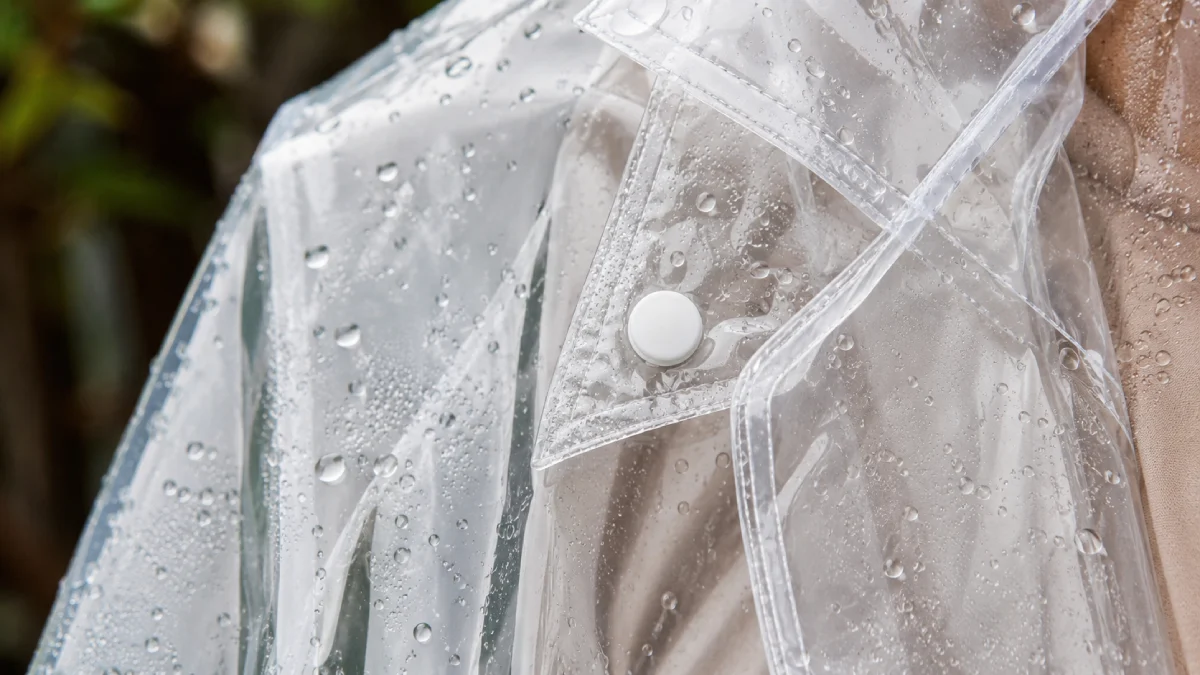
Clear raincoats can be crystal clear, smoky clear, frosted, milky, tinted, or colored transparent. These details should be confirmed before production. A buyer expecting a crystal-clear look may be disappointed if the final product has a frosted or blue-tinted appearance.
Color tone also affects branding. A logo may look different on smoky transparent material than on fully clear material. Buyers should check final samples under realistic lighting.
Printing and branding
For custom branding, buyers should confirm logo position, print size, print method, color standard, and durability. If the logo is placed on a fold line, it may experience more stress during packing and use. If the logo color is too light, it may not stand out on transparent material.
Branding should also include labels, packaging, hangtags, barcodes, and carton marks. A good product can look unprofessional if packaging details are messy.
Packaging and carton details
Packaging affects product appearance, shipping cost, and retail experience. Buyers should confirm individual bag type, folding method, pouch design, hangtag style, carton quantity, carton size, and carton marks. If the product is for Europe or major retail channels, packaging material and labeling may also need review.
Compact packaging is useful, but excessive compression can damage appearance. Buyers should balance packing efficiency with product presentation.
Sample approval and inspection
Before mass production, buyers should approve material samples, size samples, printed samples, and packaging samples. For larger orders, pre-production samples and inspection standards should be confirmed in writing.
Inspection should include material consistency, size measurement, seam quality, closure function, printing quality, packaging count, carton marks, odor, and surface appearance. For transparent products, surface defects should be checked carefully because they are more visible.
Clear Raincoats for Custom Branding and Bulk Buyers
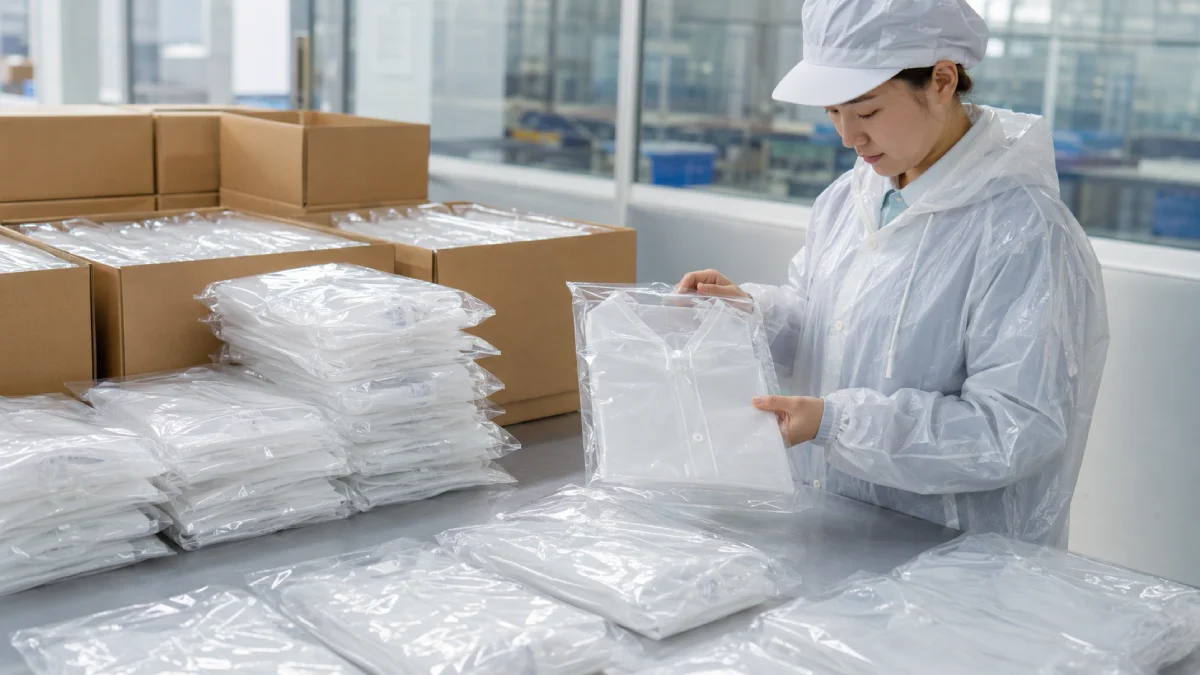
Brands developing custom rainwear should confirm logo placement, printing method, packaging style, and sample approval before moving into bulk production.
What YOUNGSTAR can support
YOUNGSTAR can support buyers developing clear raincoats, transparent raincoat styles, lightweight rainwear, promotional rainwear, children’s rainwear, and private-label rainwear programs. Depending on the target market, buyers can compare PE, EVA, PVC, TPU, and coated material options to find the right balance between cost, comfort, appearance, and durability.
For custom projects, available development areas may include material selection, thickness adjustment, color tint, transparent or frosted finish, logo printing, size grading, hood design, snap or zipper selection, pouch design, retail packaging, carton labeling, and sample approval. This allows buyers to match the product to the channel instead of forcing one generic raincoat into every market.
For clear raincoat wholesale orders, consistency matters. Buyers need stable material quality, clear packaging instructions, correct carton quantities, and inspection support. A professional supplier should help prevent problems before production, not explain them after delivery.
When to contact the factory
Buyers should contact the factory when they already know the target market, approximate order quantity, user group, and intended sales channel. Even basic information can improve product recommendations. For example, a raincoat for children’s retail should not be recommended the same way as a raincoat for a music festival giveaway.
Useful information includes target country, user age group, expected weather, disposable or reusable positioning, preferred material, logo requirements, packaging style, delivery schedule, and whether compliance documents are needed. With these details, the supplier can recommend a more suitable material and sample direction.
If buyers are unsure which material to choose, the safest step is to request comparison samples. Side-by-side samples can show differences in softness, transparency, odor, thickness, and packaging appearance. This saves time and reduces decision risk.
Final Recommendation: Are Clear Raincoats Worth Buying?
Best answer for consumers
Clear raincoats are worth buying when users want rain protection without hiding their clothing or personal style. They are especially suitable for commuting, school activities, outdoor events, travel, festivals, theme parks, and casual rainy-day use. They are not always the best choice for extreme weather, heavy outdoor work, or high-intensity sports unless the material and construction are designed for those conditions.
Consumers should choose clear raincoats based on comfort, length, hood coverage, closure quality, and whether the product is disposable or reusable. A low-cost raincoat may be enough for emergency use, while a better EVA, TPU, or higher-grade PVC raincoat is more suitable for repeated wear.
Best answer for buyers
For buyers, clear raincoats are a strong product category when the material and use case are matched correctly. PE and basic EVA can work for events, tourism, and emergency rainwear. EVA and TPU are better for reusable, retail, and comfort-focused products. Higher-grade PVC or TPU can support more structured transparent rainwear when appearance and durability matter.
The biggest risks are choosing only by price, ignoring odor, skipping print tests, using thin event products for retail, and failing to confirm packaging. Buyers should also consider compliance expectations for children’s products, plasticized materials, export markets, and retail packaging.
Final soft CTA
For buyers developing a clear raincoat line, the safest step is to confirm the target market, material, thickness, weather conditions, packaging method, logo requirements, and compliance needs before mass production. YOUNGSTAR can help compare material options, prepare samples, and recommend suitable custom clear raincoats based on the buyer’s sales channel and order requirements.
FAQ About Clear Raincoats
1. Are clear raincoats waterproof?
Yes, clear raincoats can be waterproof when they are made from suitable materials such as PE, EVA, PVC, TPU, or coated films and constructed with proper seams and closures. However, buyers should not judge waterproof performance by material alone. The finished garment must also have reliable seam construction, hood coverage, front closure design, and correct sizing to reduce the risk of water entering during real use.
2. What are clear raincoats made of?
Clear raincoats are commonly made from PE, EVA, PVC, TPU, or coated materials. PE is often used for disposable or event rainwear. EVA is soft and lightweight for casual and children’s rainwear. PVC can provide strong waterproof performance and clearer structure, while TPU is often used for higher-end transparent rainwear with better flexibility and durability. The best material depends on the target market and expected use.
3. Are clear raincoats breathable?
Most clear raincoats are less breathable than technical woven rain jackets because many transparent materials are film-based. Users may feel warm or damp during long wear or high activity. Buyers can improve comfort by choosing softer materials, looser cuts, ventilation openings, adjustable closures, and designs that allow airflow. Clear raincoats are usually best for commuting, events, travel, school use, and casual rain protection rather than intense sports.
4. Do clear raincoats turn yellow over time?
Some clear raincoats may turn yellow over time due to material formulation, UV exposure, heat, storage conditions, aging, or low-quality additives. Higher-grade materials and better storage can reduce this risk. Buyers sourcing clear raincoats for retail or premium markets should ask about yellowing resistance, review samples after storage, and avoid materials that already show a yellow tone during sample approval.
5. Are clear raincoats good for heavy rain?
Clear raincoats can work in heavy rain if the material is thick enough and the garment has good seam construction, secure closures, proper hood coverage, and sufficient length. However, many lightweight clear raincoats are designed for light to moderate rain or short-term use. Buyers should match the product to the expected weather conditions instead of assuming every clear raincoat offers the same level of protection.
6. Can clear raincoats be customized with a logo?
Yes, clear raincoats can be customized with logos, event names, brand graphics, color trim, packaging, labels, and private-label details. Because transparent materials have different surface properties, buyers should test the printing method on the final selected material before bulk production. This helps confirm logo adhesion, color visibility, surface finish, and performance after folding and packaging.
7. Which material is best for clear raincoat wholesale orders?
The best material for clear raincoat wholesale orders depends on the buyer’s market. PE is suitable for low-cost events and emergency use. EVA is a balanced choice for lightweight reusable rainwear, school programs, tourism, and casual retail. PVC can work for stronger waterproof structure, while TPU is better for premium transparent rainwear. Buyers should compare cost, softness, clarity, durability, odor, packaging, and compliance needs before deciding.
8. What should buyers check before ordering bulk clear raincoats?
Before ordering bulk clear raincoats, buyers should check material type, thickness, transparency, odor, waterproof construction, seam quality, hood design, closure type, size chart, logo printing method, packaging style, carton quantity, sample approval process, and inspection standards. These details help reduce sourcing risks and ensure the final product matches the intended market, user group, and weather conditions.
References
- “Packaging and Packaging Waste Regulation” — European Commission — EU Environment
- “Phthalates Business Guidance” — U.S. Consumer Product Safety Commission
- “Phthalates FAQ” — U.S. Consumer Product Safety Commission
- “Commission Regulation (EU) 2018/2005 amending Annex XVII to REACH” — EUR-Lex
- “REACH Annex XVII Amendment of Phthalate Restriction” — TÜV SÜD
- “ECHA Announces Revised Draft PFAS Restrictions under REACH” — SGS
- “How to Choose the Best Rain Jacket” — REI Co-op Editors — REI Expert Advice
- “Rainwear Basics” — REI Co-op Editors — REI Expert Advice
Clear Raincoats: Material, Market, and Buying Insight
Clear raincoats are not only a visual rainwear style. They are a practical product category shaped by material performance, user comfort, retail presentation, weather conditions, and compliance expectations. A transparent raincoat can help users stay dry while keeping outfits, uniforms, event clothing, or brand identity visible. For buyers, the real value comes from matching the right material and construction to the right use case instead of choosing only by price or transparency.
What makes a clear raincoat different from a standard raincoat?
A standard opaque raincoat mainly competes on waterproof protection, fabric durability, fit, and appearance. A transparent raincoat adds another layer of evaluation: clarity, yellowing resistance, surface scratches, fold marks, odor control, and visual cleanliness. Because clear materials show defects more easily, buyers need to pay closer attention to material grade, packing method, seam quality, and storage conditions. A clear raincoat that looks attractive in photos may still fail in retail if it smells strong, turns yellow, or shows deep creases after shipping.
How should buyers choose between PE, EVA, PVC, and TPU?
Material choice should follow the product’s real use. PE is suitable for disposable or short-term event rainwear where compact packing and cost control matter most. EVA is a better option for lightweight reusable rainwear, school programs, tourism, and casual retail because it usually feels softer and more comfortable. A PVC clear raincoat can provide stronger waterproof structure and clearer shape, but buyers should check odor, softness, and market compliance. A TPU clear raincoat is more suitable for premium transparent rainwear where flexibility, durability, and hand feel are more important than the lowest unit cost.
Why do regulations and packaging trends matter?
Clear raincoat sourcing is increasingly affected by chemical safety, children’s product expectations, PFAS-free waterproofing trends, and packaging regulations. Buyers selling into Europe or North America should pay attention to material documentation, restricted substances, labeling, and packaging design. For children’s rainwear, material odor, softness, drawstring safety, small parts, and testing support deserve extra review. For retail packaging, buyers should consider recyclable materials, reduced over-packaging, barcode labels, carton marks, and product protection during shipping.
Which clear raincoat option fits each market?
For outdoor festivals, stadiums, tourism sites, and emergency packs, lightweight PE or EVA raincoats are usually practical. For school rainwear and casual reusable use, EVA offers a better balance of softness, cost, and comfort. For fashion retail, frosted EVA, TPU, or higher-grade PVC can create a cleaner and more premium appearance. For promotional campaigns, custom clear raincoats with logo printing and branded packaging can protect users while keeping event outfits or uniforms visible. For premium rainwear lines, buyers should test TPU or selected high-grade materials before confirming bulk production.
What should buyers check before placing a wholesale order?
Before confirming a clear raincoat wholesale order, buyers should review material type, thickness, transparency, softness, odor, waterproof construction, hood design, closure type, seam method, size chart, logo printing method, packaging style, carton quantity, and inspection standard. Samples should be evaluated after folding, packing, opening, and wearing, not only by looking at a flat material sheet. Transparent rainwear reveals small defects quickly, so sample approval and packaging tests are especially important.
What risks should buyers avoid?
The most common mistakes include choosing only by clarity, ignoring odor, using thin event rainwear for retail, skipping logo print tests, overlooking fold marks, assuming all clear materials are equally waterproof, and forgetting market-specific compliance. These mistakes can lead to yellowing, tearing, leaking seams, poor user comfort, weak logo adhesion, unsold inventory, and customer complaints. A slightly higher-quality material may reduce long-term risk if the product is sold through retail, school, children’s, or branded channels.
How can clear raincoats support long-term business value?
A well-developed clear raincoat line can serve multiple markets, including commuting, schools, tourism, outdoor events, promotional campaigns, and private-label retail. The product is easy to understand, visually appealing, and suitable for custom branding. When supported by the right material, reliable seams, clean packaging, and stable production, clear raincoats can become more than a seasonal rain item. They can help buyers build a repeatable rainwear category with stronger user trust and clearer product differentiation.
The final recommendation is simple: choose PE or basic EVA for short-term event rainwear, EVA for lightweight reusable rainwear, PVC for stronger transparent structure, and TPU for premium transparent rainwear. For buyers developing custom or bulk clear raincoats, YOUNGSTAR can help compare material options, prepare samples, adjust packaging, and recommend a product direction based on the buyer’s market, user group, branding needs, and compliance expectations.