Why Waterproof Fabric Can Still Become a Leaking Raincoat
A buyer may choose a strong waterproof fabric, approve a promising sample, and expect the finished raincoat to perform well in real rain. The fabric may have a good waterproof rating. The material may feel thick, coated, and reliable. On paper, everything looks safe.
Then the bulk order reaches users, and complaints begin.
Water may enter around shoulder seams, sleeve seams, pocket openings, front zippers, hood seams, or rain pants crotch seams. The buyer checks the fabric again and finds that the material itself is waterproof. So what failed?
In many cases, the problem is not the fabric. It is the seam.
This is why rainwear seam construction matters in B2B sourcing. Rainwear is not sold as a flat fabric sheet. It is sold as a finished garment with seams, zippers, pockets, hoods, cuffs, hems, stress points, and packaging folds. A fabric can pass a waterproof test, but the finished garment may still leak if the seam method is wrong.
Buyers who are still comparing fabric-level performance can first review our Waterproof Rating Guide to understand why fabric testing and finished garment waterproofness should be evaluated separately.
For PVC-based products, high-frequency welding can help reduce leakage caused by needle holes because it bonds compatible material layers without traditional stitching. This makes it useful for PVC raincoats, rain ponchos, industrial waterproof garments, waterproof aprons, fishing rainwear, and protective clothing.
However, high-frequency welding is not suitable for every fabric. PU, TPU, nylon, polyester, and waterproof-breathable laminated fabrics may require seam taping, heat sealing, stitching, or mixed construction instead. The right seam method depends on material, product use, waterproof claim, production budget, and target market.
For professional waterproof garment production, seam construction must be decided before bulk production—not after leakage complaints arrive.
What Is High-Frequency Welding?
Simple Definition for Rainwear Buyers
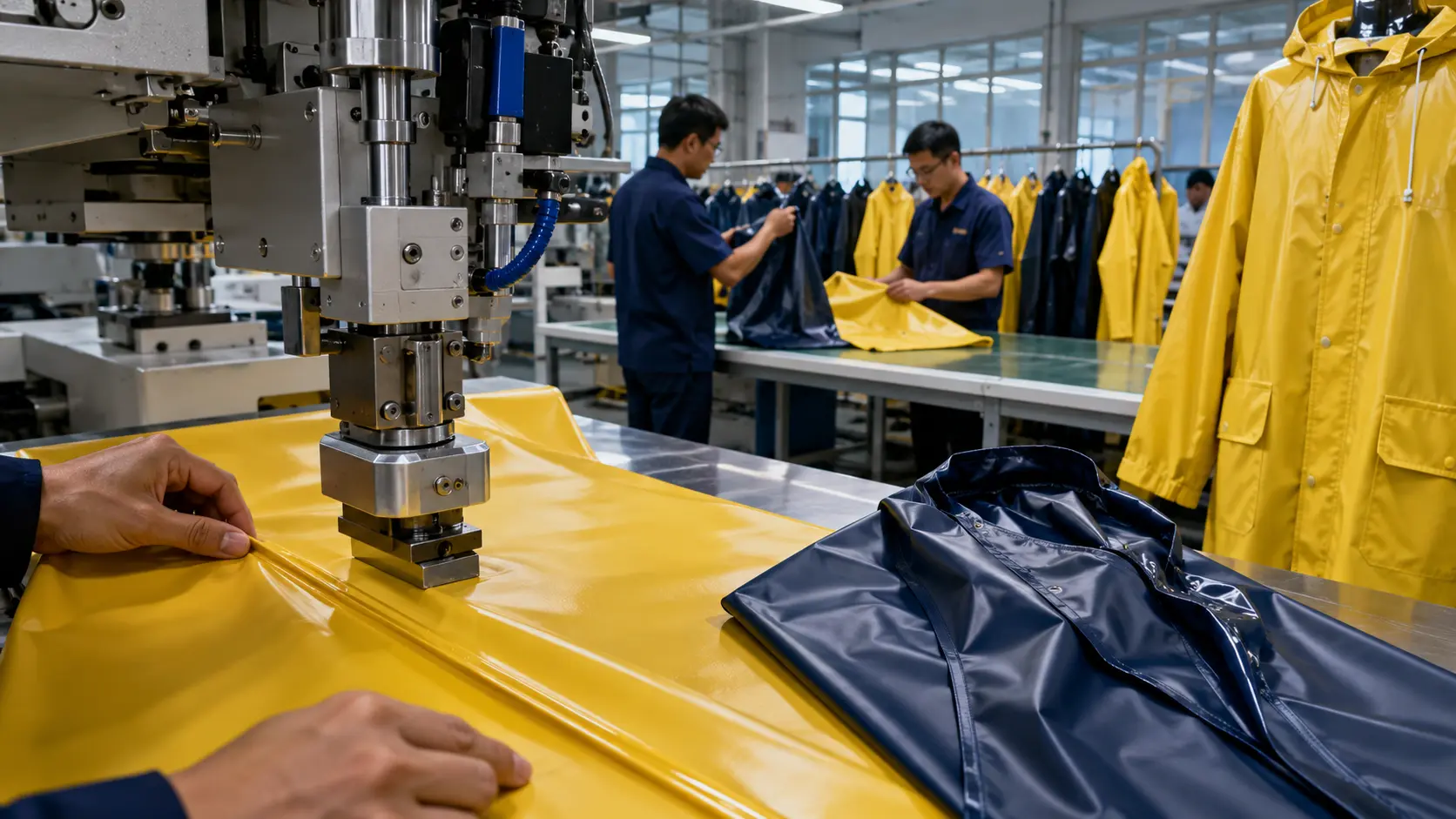
High-frequency welding, also known as RF welding or radio-frequency welding, is a bonding process that uses radio-frequency energy and pressure to join compatible thermoplastic materials. In rainwear production, it is especially common for PVC-based materials because PVC responds well to this process.
Instead of sewing material panels together with thread, high-frequency welding fuses compatible layers into a sealed joint. This can reduce seam leakage because the process does not rely on needle holes.
A simple way to compare seam methods is this:
Stitching joins fabric with thread.
Seam taping covers stitched seams with waterproof tape.
Heat sealing uses heat and pressure to seal suitable materials.
High-frequency welding uses RF energy and pressure to bond compatible materials together.
This is why PVC rainwear welding is often used for products where waterproof integrity is more important than soft apparel-like construction.
How the Process Works
The basic process is straightforward. Two compatible material layers are overlapped. A shaped welding die applies pressure. Radio-frequency energy heats the material internally. The softened layers bond together. After cooling, the seam becomes a welded joint.
The result depends on several factors:
Material compatibility
Material thickness
Welding pressure
RF energy level
Welding time
Cooling time
Seam width
Tooling design
Operator skill
Production consistency
If these factors are controlled well, the welded seam can be strong, clean, and water-resistant. If they are poorly controlled, the seam may look acceptable at first but fail during pulling, folding, packing, or field use.
For B2B buyers, the key question is not only whether a factory can weld rainwear. The better question is how the factory controls the rainwear welding process during sample development and bulk production.
Why It Is Common in PVC-Based Rainwear
PVC is one of the most suitable materials for high-frequency welding. That is why this process is commonly used in PVC raincoats, rain ponchos, industrial waterproof garments, fishing rainwear, waterproof aprons, PVC rain pants, and protective clothing.
Common welded PVC rainwear products include:
PVC raincoats
Rain ponchos
Industrial rain suits
Waterproof aprons
Fishing rainwear
PVC rain pants
Protective waterproof garments
Certain utility waterproof products
For buyers sourcing PVC rainwear fabric products, seam method should be discussed early. A PVC product may be stitched, heat-sealed, welded, or produced with mixed construction depending on design and cost. Assuming all PVC rainwear is automatically welded is a common mistake.
Why Seam Construction Matters More Than Many Buyers Realize
Fabric Waterproof Rating vs Finished Garment Waterproofness
Many buyers spend time comparing fabric waterproof ratings but overlook seam construction. This creates a serious sourcing gap.
A fabric may resist water pressure as a flat textile sample. But when that fabric is cut and assembled into a garment, every seam becomes a potential weak point. Every zipper opening, pocket edge, hood seam, sleeve joint, and hem line can affect real waterproof performance.
This is why waterproof seam sealing should be evaluated together with material selection.
A buyer may choose a 10,000mm waterproof fabric, but if the garment is stitched without sealing, rain can still enter through needle holes. A buyer may select heavy PVC material, but if the welded seam is too narrow or inconsistent, the seam may split or leak. A buyer may use laminated PU fabric, but if the seam tape does not match the coating, tape failure may occur after washing or folding.
Finished rainwear waterproofness depends on the complete system:
Fabric waterproof rating
Material type
Seam method
Zipper protection
Hood structure
Cuff design
Pocket design
Coating durability
Welding or taping quality
Finished sample testing
Bulk production QC
A professional rainwear manufacturer waterproof seams process must review both fabric performance and garment-level construction.
Where Rainwear Usually Leaks
Rainwear leakage often appears in predictable areas. These areas deserve extra attention during sample approval and inspection.
Common leakage points include:
Shoulder seams
Sleeve seams
Side seams
Front zipper area
Pocket openings
Hood seam
Neck opening
Cuffs
Hem areas
Rain pants crotch seams
Reflective tape stitching areas
Logo application areas
Shoulder seams are critical because rain hits the upper body directly. Backpack straps may also increase water pressure in that area. Rain pants crotch seams are another high-risk point because they face movement, stretching, sitting pressure, and repeated friction.
For workwear rain suits, buyers should review stress points carefully because workers bend, kneel, lift, carry, and move in wet environments. A seam that looks fine on a hanger may behave differently in real use.
Why Stitching Can Create Leakage Risk
Stitching is widely used in garment production because it is flexible, efficient, and suitable for many fabrics. But in waterproof rainwear, stitching creates needle holes. If these holes are not sealed, water may pass through.
This does not mean stitching is always wrong. Many rainwear products use stitching successfully, especially when combined with seam taping or used in low-risk areas. For fashion raincoats, lightweight jackets, or light-rain products, stitched construction may be acceptable.
The problem appears when buyers expect full waterproof performance but approve stitched seams without additional sealing.
A stitched seam can work for water-resistant rainwear. It is riskier for waterproof workwear, PVC rainwear, storm protection, rain pants, or long-exposure outdoor rainwear.
Why Seam Method Should Match the Material
Different rainwear materials need different seam methods.
PVC often works well with high-frequency welding or heat sealing. PU-coated fabrics may be more suitable for stitching with seam taping
For buyers comparing material compatibility before choosing a seam method, this PU vs PVC rainwear comparison explains why PVC, PU, and coated fabrics often require different waterproof construction methods.
. TPU laminated fabrics are commonly used with seam taping in technical rain jackets. PEVA and EVA may use heat sealing or simple welding depending on product grade.
A seam method that works well for one material may fail on another.
Using high-frequency welding on unsuitable fabric may cause weak bonding, surface damage, or uneven seams. Using seam tape on an incompatible coating may cause poor adhesion. Using stitching alone for a heavy waterproof claim may lead to leakage.
The material and seam method must be selected together.
Common Seam Construction Methods in Rainwear
Stitched Seams
Stitched seams are made by sewing fabric panels together with thread. This is the most familiar garment construction method and is widely used in apparel.
The advantage is flexibility. Stitching can handle complex garment shapes, curved seams, linings, zippers, trims, and soft fabrics. It is also cost-efficient and widely available.
The risk is leakage through needle holes. If the product is designed for light rain or fashion use, this may be acceptable. If the product must resist heavy rain, stitched seams usually need additional sealing.
Stitched seams are common in:
Light rain jackets
Fashion raincoats
PU rainwear
Lined rainwear
Non-critical seam areas
Products with seam taping
Basic promotional rainwear
For buyers, stitched seams are not automatically bad. The key is whether the waterproof claim matches the construction method.
Taped Seams
Taped seams are created by applying waterproof seam tape over stitched seams. This method is common in outdoor rain jackets, laminated fabrics, PU-coated fabrics, TPU fabrics, and waterproof-breathable apparel.
The tape covers needle holes and helps prevent water from entering through the seam. Seam taping is especially important for products that need stronger waterproof performance but use fabrics that are not suitable for high-frequency welding.
The quality of seam taping depends on tape compatibility, temperature, pressure, machine control, fabric coating, operator skill, and post-production inspection. If the tape does not bond properly, it may peel, bubble, crack, or fail after washing and folding.
Taped seams are common in:
Outdoor rain jackets
Cycling rainwear
Waterproof-breathable jackets
PU-coated rain jackets
TPU laminated shells
Technical rainwear
For buyers comparing PU vs PVC rainwear comparison topics, this distinction matters. PVC may be welded, while PU and TPU fabrics are often stitched and taped.
Heat Sealing
Heat sealing uses heat and pressure to seal compatible materials. It may be used for certain coated fabrics, ponchos, disposable rainwear, and simple waterproof products.
Heat sealing can be useful for cost-sensitive products and simple waterproof structures. However, process control matters. Too much heat may damage the material, while too little heat may create weak sealing.
Heat sealing is often used in:
Disposable ponchos
Economical rainwear
Certain coated fabrics
Simple waterproof products
Short-use rain protection
Buyers should check edge strength, flexibility, and leakage risk before approving heat-sealed products.
High-Frequency Welding
High-frequency welding is especially valuable for PVC and compatible coated materials. It can create waterproof seams without traditional stitching, helping reduce needle-hole leakage and improve seam integrity.
HF welding is often used in:
PVC raincoats
Rain ponchos
Industrial rainwear
Waterproof aprons
Fishing rainwear
Protective garments
PVC rain pants
Heavy-duty waterproof workwear
The advantage is stronger seam waterproofness when the material and process are suitable. The limitation is that not every fabric can be welded this way. Buyers must confirm compatibility before choosing this method.
Seam Construction Method Comparison
| Seam Method | Suitable Materials | Best Use | Main Advantage | Main Risk |
|---|---|---|---|---|
| Stitched seam | Most woven fabrics, PU fabrics, lined garments | Light rainwear, fashion raincoats, non-critical areas | Flexible, cost-efficient, suitable for complex designs | Needle holes can leak if not sealed |
| Seam taping | PU, TPU, laminated fabrics, waterproof-breathable materials | Outdoor jackets, cycling rainwear, technical rainwear | Covers needle holes and improves waterproofness | Tape may fail if material or process is mismatched |
| Heat sealing | PEVA, EVA, some coated fabrics | Ponchos, simple waterproof garments, short-use rainwear | Good for selected waterproof seams | Requires accurate heat and pressure control |
| High-frequency welding | PVC and compatible coated materials | PVC rainwear, rain ponchos, industrial rainwear, protective garments | Strong watertight seam without stitching | Not suitable for all fabrics and requires process control |
This comparison helps buyers avoid one common sourcing mistake: choosing the seam method before confirming the material. The seam method should follow the fabric, product use, and waterproof claim.
High-Frequency Welding vs Seam Taping vs Stitching
When High-Frequency Welding Is Better
High-frequency welding is usually better when the product uses PVC or compatible waterproof materials and requires strong watertight seams.
It is especially valuable for:
PVC rainwear
Industrial raincoats
Rain ponchos
Waterproof aprons
Fishing rainwear
PVC rain pants
Protective waterproof clothing
Heavy-duty rain suits
In these products, buyers usually care about waterproof integrity, seam strength, easy cleaning, and rugged performance. The product may be more functional than fashion-oriented, and water protection may matter more than soft hand feel.
For a waterproof workwear manufacturer, high-frequency welding can be a strong process when the garment structure and material are suitable.
When Seam Taping Is Better
Seam taping is often better for fabrics that need stitching first, such as PU-coated fabrics, TPU laminated fabrics, waterproof-breathable membranes, and technical rain jacket materials.
It is common in:
PU rain jackets
TPU laminated jackets
Outdoor shells
Cycling jackets
Hiking rainwear
Lightweight waterproof-breathable garments
These products often require comfort, lighter weight, flexibility, breathability, and apparel appearance. High-frequency welding may not be suitable for these materials, so seam taping becomes the more realistic waterproofing method.
When Stitching Is Still Acceptable
Stitching may still be acceptable for certain rainwear products, especially if the product is designed for light rain, short-term use, fashion appearance, or non-critical seam areas.
Stitching may be suitable for:
Basic rainwear
Fashion raincoats
Low-risk seam areas
Products with water-resistant claims
Cost-sensitive promotional rainwear
The key is honest product positioning. If the product is only designed for light rain, stitched construction may be enough. If the product is marketed as waterproof workwear or heavy-rain protection, stitching alone is risky.
Why High-Frequency Welding Is Valuable for PVC Rainwear
Better Waterproof Integrity
For PVC-based rainwear, high-frequency welding can reduce one of the biggest leakage risks in waterproof garments: needle holes.
Traditional stitching uses thread to join panels together. That method works well for many apparel products, but in waterproof rainwear, every needle hole can become a possible water entry point. When the product is exposed to heavy rain, pressure, movement, or folding, those holes may allow leakage unless they are sealed properly.
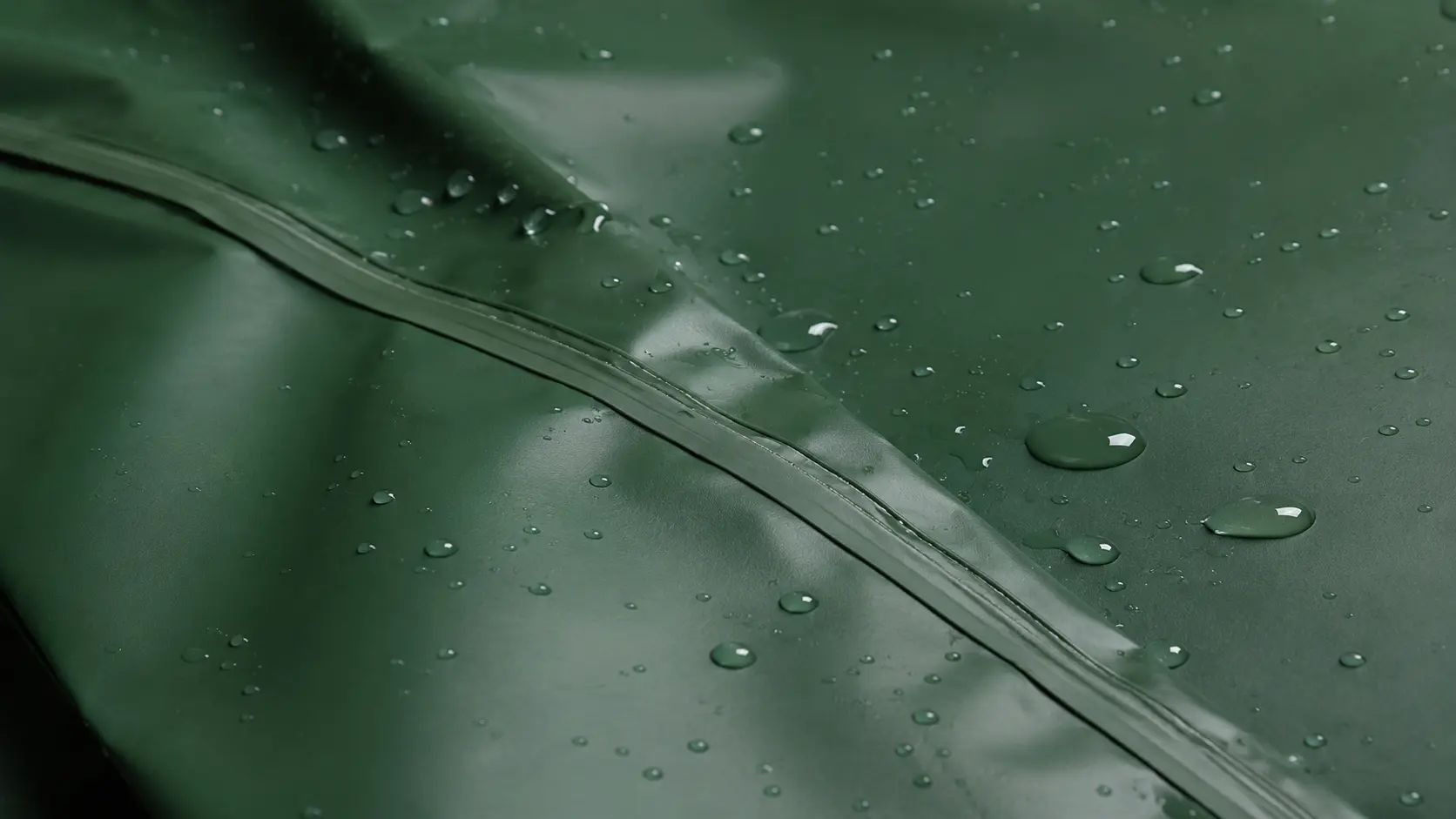
With PVC rainwear welding, compatible material layers can be bonded together without traditional sewing. This helps create a more continuous waterproof connection between panels.
A welded seam does not automatically make the entire garment perfect, but it can significantly improve seam waterproofness when the material, seam width, tooling, and process are controlled correctly.
Stronger Seam Bonding
High-frequency welding does not simply cover a seam. It bonds compatible thermoplastic layers together. This is different from applying tape over a stitched seam or using thread to hold two panels in place.
When the welding process is controlled properly, the bonded area can become strong and water-resistant. This is one reason PVC raincoat welding is widely used in products that need direct waterproof protection.
For B2B buyers, seam strength is not only about leakage. It also affects pulling, folding, wearing, packing, and field use. Industrial rainwear and waterproof workwear may face more stress than casual rain jackets. Workers may bend, carry tools, kneel, lift, or work around wet equipment.
This is why welded seam quality should be checked during sample approval.
Cleaner Appearance for Utility Waterproof Products
High-frequency welding can also create a clean and functional seam appearance. For PVC rainwear, rain ponchos, waterproof aprons, and protective garments, a neat welded seam can improve product consistency and perceived quality.
This does not mean welded seams always look more fashionable than stitched seams. In many apparel-style rain jackets, stitching and seam taping may look more suitable. But for PVC-based waterproof products, welding can create a practical and purpose-built appearance.
A PVC workwear raincoat does not need to look like a soft fashion jacket. It needs to look reliable, sealed, and protective.
Efficient Bulk Production for Suitable Designs
High-frequency welding can support efficient production when the product design is suitable. Repeated seam shapes, simple panel structures, ponchos, PVC rain pants, protective aprons, and industrial rainwear components can often be produced efficiently with proper tooling and equipment.
However, tooling and setup matter. If the garment design is complex, has many curves, includes multiple layers, or uses uneven material thickness, welding may become more difficult.
A factory with experience in waterproof garment production should review the design before confirming whether welding is the best method.
Limitations of High-Frequency Welding Buyers Should Know
Not Suitable for Every Fabric
High-frequency welding is powerful, but it is not suitable for every rainwear fabric.
PVC and certain compatible coated materials often respond well to RF welding. Ordinary polyester, nylon, some PU-coated fabrics, and many waterproof-breathable laminated fabrics may not weld properly through this method. These fabrics may require stitching, seam taping, heat sealing, or other construction methods.
If the fabric is not suitable, welding may create weak bonding, surface damage, uneven seams, or poor durability. In that case, seam taping or another method may be more reliable.
Tooling and Mold Requirements
High-frequency welding usually requires suitable tooling or dies. The tool shape determines the seam line, pressure area, and final welded appearance.
For simple rain ponchos or straight seam areas, tooling may be easier. For more complex rainwear designs, shaped panels, curved seams, pockets, or detailed structures, tooling becomes more important.
Buyers should ask whether tooling is required for the specific design and whether any mold cost or development time is involved.
Process Control Matters
Welding quality depends on process control.
Important factors include:
Material thickness
Material compatibility
Welding pressure
RF energy level
Welding time
Cooling time
Seam width
Tool alignment
Operator experience
Machine maintenance
If pressure is too low, the seam may not bond strongly. If the process is too aggressive, the material may become damaged. If seam width is too narrow, durability may suffer. If alignment is inconsistent, the finished garment may look uneven or fail inspection.
A supplier may say it can weld rainwear, but buyers should still ask how it inspects welded seams during production.
Design Limitations
High-frequency welding may not be ideal for every garment design.
Complex curved seams, bulky areas, thick multi-layer structures, soft linings, decorative trims, and small detailed components may be harder to weld consistently. In some cases, mixed construction may be more practical: welding for key waterproof seams, stitching for non-critical areas, and sealing or taping where needed.
Seam construction should be discussed before finalizing the sample. If the buyer confirms a complicated design first and asks about waterproofing later, the factory may need to revise the structure, increase cost, or adjust production methods.
Compliance and Material Safety Still Matter
A strong welded seam does not automatically mean the material is compliant.
For PVC rainwear, buyers may still need to check plasticizers, phthalates, pigments, heavy metals, odor, restricted substances, and target-market requirements. If the product is for children, Europe, North America, outdoor brands, or institutional buyers, material safety should be reviewed early.
PFAS-free finishing and chemical compliance trends may also affect certain waterproof textile products, especially where surface treatments or performance coatings are used.
Seam construction improves waterproof performance. Compliance review protects market access.
Waterproof Seam Testing: What Buyers Should Ask Suppliers
Finished Garment Testing Is More Important Than Fabric Claims
A fabric test is useful, but it does not prove the whole rainwear product is waterproof.
Because seam testing is part of professional waterproof garment production, buyers should review sample development, seam inspection, material control, and QC procedures before confirming bulk orders.
Buyers should review finished samples and seam areas before confirming bulk production. This is especially important when the product is sold as seam sealed rainwear, PVC rainwear, industrial rainwear, waterproof workwear, rain ponchos, or protective clothing.
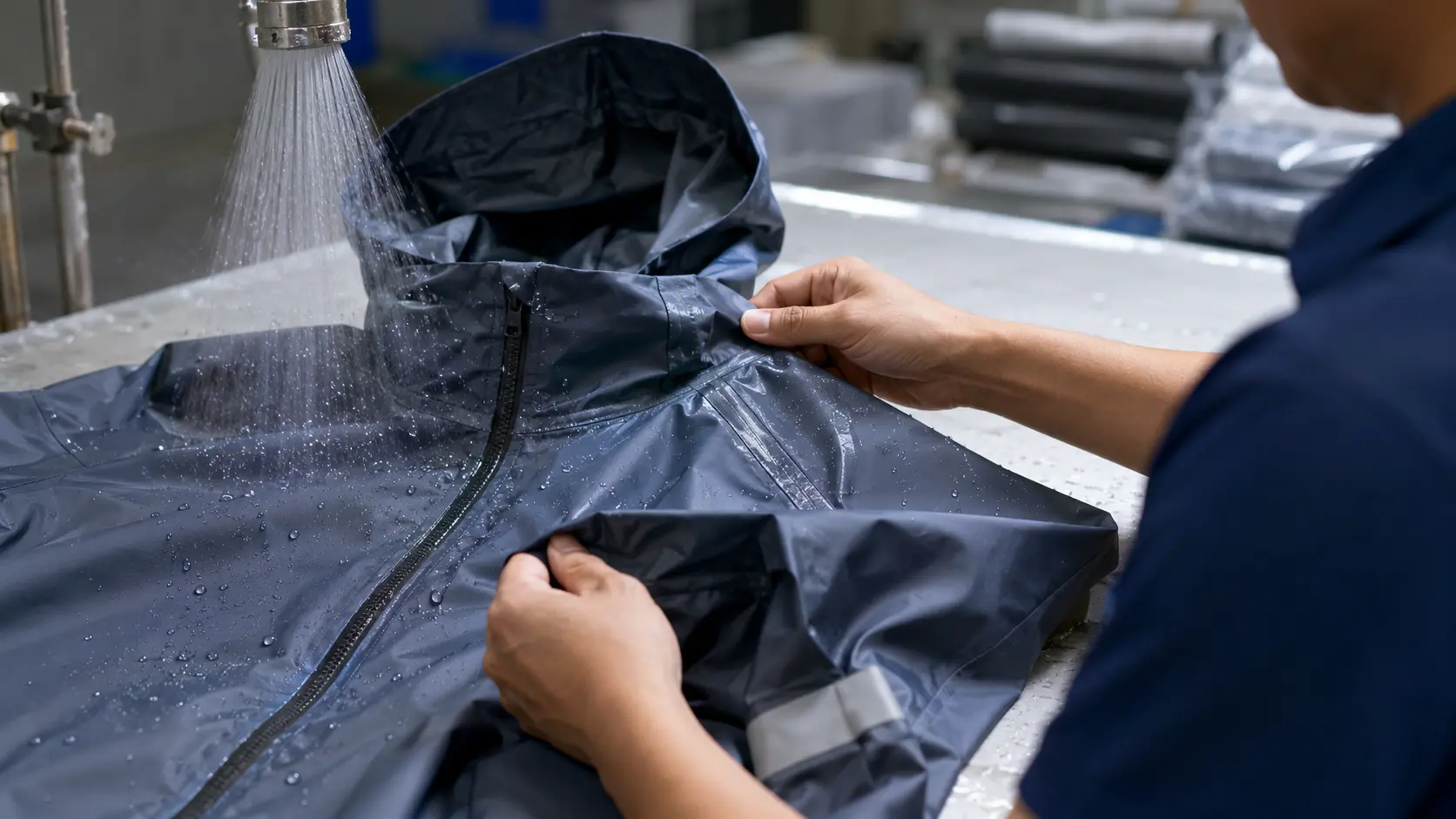
Finished garment testing may include visual inspection, water spray checks, seam pulling, folding review, leakage observation, and comparison between pre-production samples and bulk goods.
For large orders, buyers should not rely only on supplier promises. They should ask for sample photos, inspection reports, or third-party testing if the order requires higher assurance.
Practical Inspection Points for Rainwear Seams
During sample approval, buyers should inspect the most important seam and opening areas.
Key inspection points include:
Shoulder seams
Sleeve seams
Side seams
Hood seams
Front zipper area
Pocket openings
Cuff areas
Hem seams
Rain pants crotch seams
Reflective tape areas
Welded seam width
Welded seam flexibility
Peel strength
Leakage after folding
Leakage after pulling
For welded seams, buyers should pay attention to seam width and consistency. A weld that looks clean but is too narrow may not provide enough long-term durability. A weld that is uneven may indicate poor pressure control or alignment issues.
Supplier Questions for Seam Construction
Buyers should ask specific questions before ordering.
What seam method will be used?
Is the material suitable for high-frequency welding?
Will the product use welding, heat sealing, stitching, or seam taping?
What is the welded seam width?
Can the seam pass a leakage test?
Can the factory test finished samples before bulk production?
How does the factory inspect welded seams during production?
Can QC photos be provided?
Is the seam method the same for sample and bulk production?
Will folding or packing affect seam durability?
These questions help buyers avoid one of the most common sourcing problems: approving a nice-looking sample without confirming how waterproof performance will be controlled in mass production.
Compliance and Market Trends: Why Seam Construction Is Becoming More Important
Rainwear Buyers Expect Better Finished Product Performance
The global rainwear market continues to grow, supported by outdoor activities, workwear demand, commuting needs, climate variability, and demand for better protective apparel. Market research estimates the global rainwear market at over USD 4 billion in 2024, with continued growth expected toward 2030.
This growth means buyers are not only looking for cheap rain protection. Many buyers want better comfort, durability, product consistency, and lower complaint rates.
Seam construction plays a central role in this shift. A product that looks waterproof but leaks at the seams will not satisfy modern buyers.
Regulations and Chemical Expectations Are Changing Material Decisions
Rainwear buyers are also paying more attention to chemical safety and market compliance. Waterproof products may involve coatings, plasticizers, surface treatments, pigments, adhesives, tapes, and other material components.
For PVC rainwear, buyers may need to ask about phthalate-free options, restricted substances, odor control, pigments, and target-market requirements. For products using water-repellent treatments, PFAS-free options may be important, especially for European and brand-sensitive markets.
Seam construction does not replace compliance. It should be part of a broader sourcing review that includes material performance, chemical safety, durability, and finished product quality.
Better Seam Construction Can Support Longer Product Life
A stronger seam can help extend product life. If seams fail early, the garment becomes useless even when the fabric remains waterproof. This leads to returns, waste, complaints, and replacement costs.
For buyers focused on sustainability, durability matters. A longer-lasting raincoat can reduce waste more effectively than a product that fails after limited use. High-quality seam construction, suitable materials, and good QC can support longer service life.
This does not mean every product needs premium construction. A disposable poncho and an industrial rain suit should not be built the same way. But each product should have seam construction that matches its expected use.
Common Mistakes Buyers Make With Rainwear Seams
Mistake 1: Asking Only for Waterproof Fabric
Many buyers ask for waterproof fabric but forget to ask how the garment seams will be constructed.
This is a major mistake. Fabric waterproofness is only one part of rainwear performance. If the seams are weak, unsealed, or poorly welded, the final garment may leak even when the fabric is strong.
A better sourcing question is: what fabric will be used, and how will the seams be made waterproof?
Mistake 2: Assuming All PVC Rainwear Is Welded
PVC is suitable for welding, but that does not mean every PVC raincoat is made with high-frequency welding.
Some PVC rainwear may use stitching, heat sealing, mixed construction, or partial welding depending on style, price point, and factory process. Buyers should confirm the method clearly before sample approval.
For serious PVC rainwear welding projects, buyers should ask for seam details, finished samples, and leakage checks.
Mistake 3: Using High-Frequency Welding on Unsuitable Materials
High-frequency welding works best with compatible materials. If buyers request welding on unsuitable fabrics, the result may be weak, uneven, or damaging to the material.
For PU, TPU, nylon, polyester, or waterproof-breathable fabrics, seam taping may be more appropriate. The factory should help buyers choose the right seam method based on material and product use.
Mistake 4: Ignoring Seam Width and Peel Strength
A welded seam can look neat but still fail if the weld is too narrow or weak. Buyers should pay attention to seam width, bonding consistency, flexibility, and peel resistance.
For industrial rainwear, fishing rainwear, waterproof aprons, and workwear rain suits, seam strength is especially important because the garment may face pulling, bending, and repeated movement.
Mistake 5: Approving a Flat Fabric Sample Only
A flat fabric sample tells buyers how the material feels and looks. It does not show how the final garment performs.
Before bulk production, buyers should approve a finished sample with the correct material, seam method, zippers, pockets, hood, logo, reflective tape, packaging, and size.
Mistake 6: Using One Seam Method for Every Rainwear Category
Not every rainwear product needs the same seam construction.
A disposable poncho may use simple heat sealing. A PVC raincoat may benefit from high-frequency welding. A PU rain jacket may need stitched seams with seam taping. A technical outdoor shell may require precise seam tape control. A children’s raincoat may need safer, softer seam edges.
Buyers should match seam method with product category and user expectations.
Recommended Seam Method by Product Type
| Product Type | Recommended Seam Method | Why It Fits | Buyer Checkpoint |
|---|---|---|---|
| Disposable poncho | Heat sealing or simple welding | Supports low cost and fast production | Check edge strength and leakage |
| PVC raincoat | High-frequency welding or heat sealing | Improves waterproof seam integrity | Check weld width and flexibility |
| Industrial rainwear | HF welding, reinforced seams, or sealed seams | Supports heavy rain and rough use | Check peel strength and seam durability |
| PU rain jacket | Stitched seams with seam taping | Better for coated or laminated apparel fabrics | Check tape adhesion and waterproof claim |
| TPU laminated jacket | Seam taping | Common for technical shell construction | Check temperature and pressure control |
| Children’s rainwear | Depends on material and safety requirements | Comfort and safety matter | Check odor, softness, and seam edges |
| Rain pants | Welded, sealed, or reinforced crotch and side seams | High-pressure movement areas need protection | Check crotch seam leakage and flexibility |
| Fishing rainwear | Welding or reinforced waterproof seams | Heavy water exposure and rugged use | Check seam strength and cleaning durability |
Why Work With a Professional Rainwear Manufacturer
A professional rainwear manufacturer should not only ask what fabric the buyer wants. The supplier should help decide which seam method fits the product.
A good factory should ask:
What material will be used?
Is the product PVC, PU, TPU, PEVA, EVA, polyester, or laminated fabric?
Will the garment be used in light rain or heavy rain?
Is the product for workwear, promotion, children, outdoor, or retail?
Does the buyer need seam sealed rainwear?
Will the garment require welding, taping, stitching, or mixed construction?
What waterproof claim will be made?
What target market and compliance requirements apply?
What is the expected order quantity?
CHN Rainwear can support buyers with material selection, sample development, seam construction review, waterproof testing, and custom rainwear production for ponchos, rain jackets, workwear raincoats, PVC rainwear, and private-label waterproof garments.
For buyers comparing seam methods, the best starting point is a product requirement discussion. Once the material, use case, and waterproof expectation are clear, the right construction method becomes easier to recommend.
Final Recommendation: Do Not Separate Fabric Waterproofness From Seam Construction
Waterproof fabric is only half the story. Seam construction decides whether that waterproof performance survives in the finished garment.
For PVC-based rainwear, high-frequency welding can be a strong solution when material compatibility, design, and process control are correct. For PU, TPU, and laminated fabrics, seam taping may be more suitable. For light rainwear or cost-sensitive promotional products, stitched seams may be acceptable if the waterproof claim is realistic.
The safest B2B sourcing approach is to define the product use first, then choose the seam method. A rain poncho, PVC workwear raincoat, school rain jacket, cycling shell, and fishing rain suit should not use the same construction logic.
For buyers planning wholesale rainwear, workwear raincoats, rain ponchos, or private-label waterproof garments, seam construction should be discussed before bulk production.
For industrial buyers, a waterproof workwear raincoat should be reviewed by fabric type, seam method, zipper protection, hood structure, and finished garment waterproof performance.
It is easier to prevent leakage during sampling than to fix it after shipment.
Conclusion: Better Rainwear Needs Better Seam Decisions
Rainwear performance depends on more than waterproof fabric. A finished garment must protect against rain through its seams, openings, hood, cuffs, zippers, pockets, and stress points.
High-frequency welding is an important option for compatible PVC-based rainwear because it can improve waterproof seam integrity and reduce leakage caused by needle holes. But it is not suitable for every material or every design. Seam taping, heat sealing, and stitching all have their place when used correctly.
For B2B buyers, the best seam method is the one that matches the material, product use, waterproof claim, user expectation, and production process. When seam construction is selected properly, rainwear becomes more reliable, more consistent, and more suitable for real-world use.
CHN Rainwear can help buyers evaluate waterproof seam sealing, compare seam methods, prepare finished samples, and develop custom rainwear for promotional, workwear, PVC, outdoor, and private-label rainwear projects.
If you are planning a welded PVC rainwear, seam sealed rainwear, workwear raincoat, or private-label waterproof garment project, you can contact CHN Rainwear for seam construction recommendations before confirming samples or bulk production.
FAQ
1. What is high-frequency welding in rainwear?
High-frequency welding in rainwear is a bonding process that uses radio-frequency energy and pressure to join compatible waterproof materials, especially PVC and certain coated fabrics. Instead of sewing through the material with thread, the process fuses material layers together to create a sealed joint. This can reduce leakage risk caused by needle holes and improve seam waterproofness in suitable products. High-frequency welding is commonly used in PVC raincoats, rain ponchos, industrial rainwear, waterproof aprons, fishing rainwear, and certain protective garments. However, it is not suitable for every fabric. Buyers should confirm material compatibility, seam width, welding strength, and finished sample performance before placing bulk orders.
2. Is high-frequency welding better than stitching for waterproof rainwear?
High-frequency welding can be better than stitching for waterproof rainwear when the material is suitable, especially for PVC-based products. Traditional stitching creates needle holes, which may allow water to enter unless the seam is taped or sealed. High-frequency welding bonds compatible material layers together without traditional needle holes, making it useful for PVC rainwear, rain ponchos, industrial waterproof garments, and waterproof workwear. However, stitching is still useful for many garment structures, especially PU, TPU, and laminated fabrics that may need seam taping instead of welding. The better method depends on material type, product use, waterproof claim, design complexity, and production budget.
3. Why do rainwear seams leak?
Rainwear seams leak because the seam area is often weaker than the flat fabric surface. Stitched seams create needle holes that can allow water to pass through. Zipper openings, pocket edges, hood seams, cuffs, hems, and rain pants crotch seams can also become leakage points if they are not designed or sealed properly. Even when the fabric has a strong waterproof rating, the finished garment may fail if seam construction is poor. Movement, folding, sitting, kneeling, backpack pressure, and wind-driven rain can increase water pressure on seam areas. Buyers should check seam method, seam sealing, welded seam width, tape adhesion, and finished sample testing before bulk production.
4. Which rainwear materials are suitable for high-frequency welding?
High-frequency welding is most suitable for PVC and certain compatible coated materials because they can respond well to radio-frequency energy and pressure. This is why PVC rainwear, PVC raincoats, rain ponchos, industrial rain suits, waterproof aprons, fishing rainwear, and some protective garments often use welding. However, ordinary polyester, nylon, some PU-coated fabrics, and many waterproof-breathable laminated fabrics may not be suitable for high-frequency welding. These materials may require stitching, seam taping, heat sealing, or other construction methods. Buyers should not request welding automatically. They should first confirm material compatibility with the rainwear manufacturer.
5. Is seam taping the same as high-frequency welding?
No, seam taping and high-frequency welding are different processes. Seam taping usually covers stitched seams with waterproof tape to block water from entering through needle holes. It is commonly used in PU rain jackets, TPU laminated jackets, outdoor shells, cycling rainwear, and waterproof-breathable garments. High-frequency welding uses radio-frequency energy and pressure to bond compatible materials together, often without traditional stitching. It is commonly used for PVC rainwear, rain ponchos, industrial waterproof garments, and protective products. Seam taping is often better for laminated apparel fabrics, while high-frequency welding is often better for compatible PVC-based waterproof products.
6. What should buyers check before ordering welded PVC rainwear?
Before ordering welded PVC rainwear, buyers should check material compatibility, PVC thickness, welded seam width, seam flexibility, peel strength, leakage resistance, sample quality, and bulk production consistency. They should ask whether the garment uses high-frequency welding, heat sealing, stitching, or mixed construction. Buyers should also review key leakage points such as shoulder seams, sleeve seams, pocket openings, hood seams, zipper areas, and rain pants crotch seams. For export markets, buyers should also confirm phthalate-free options, restricted substance compliance, odor control, and target-market requirements if needed. A finished pre-production sample should be approved before bulk production.
7. Does high-frequency welding make rainwear 100% waterproof?
High-frequency welding can significantly improve seam waterproofness for compatible materials, but it does not automatically make every rainwear product 100% waterproof in all conditions. Final waterproof performance still depends on material quality, seam design, welding width, process control, zipper protection, hood structure, cuffs, pockets, stress points, quality inspection, and real-use conditions. A welded PVC seam may perform very well, but the garment can still leak through other openings if they are poorly designed. Buyers should treat high-frequency welding as an important waterproof construction method, not a guarantee by itself. Finished sample testing remains essential before bulk orders.
References
- High-Frequency Welding - An Overview
Author/Organization: ScienceDirect
Source: ScienceDirect Topics - Why RF Welding Is Essential for Outdoor & Military Gear
Author/Organization: Carolina CoverTech
Source: Carolina CoverTech - Perfect Awning Seams with High-Frequency Welding
Author/Organization: Miller Weldmaster
Source: Miller Weldmaster - Global Rainwear Market Size & Outlook, 2024–2030
Author/Organization: Grand View Research
Source: Grand View Research - France Publishes Updated PFAS Regulation for Consumer Products
Author/Organization: SGS
Source: SGS Safeguards - PFAS Compliance: Why 2026 Is a Critical Year for Europe
Author/Organization: Enhesa
Source: Enhesa - OEKO-TEX Standard 100: Product Class and Textile Safety Criteria
Author/Organization: OEKO-TEX Association
Source: OEKO-TEX - Protective Clothing: Managing Performance and Safety Requirements
Author/Organization: European Committee for Standardization
Source: CEN
Seam Construction Insights for Waterproof Rainwear Buyers
What role does high-frequency welding play in rainwear production? High-frequency welding uses radio-frequency energy and pressure to bond compatible waterproof materials, especially PVC and certain coated fabrics. Unlike stitched seams, which create needle holes, welded seams can help form a more continuous waterproof joint. This makes the process valuable for PVC rainwear, rain ponchos, industrial waterproof garments, fishing rainwear, rain pants, and waterproof workwear where seam leakage is a major buyer concern.
Why does seam construction matter as much as waterproof fabric? A rainwear fabric may have a strong waterproof rating, but the finished garment can still leak through shoulder seams, sleeve seams, zipper openings, pocket edges, hood seams, cuffs, hems, or rain pants crotch seams. Waterproof fabric is only one part of the product. Finished rainwear performance depends on fabric rating, waterproof seam sealing, seam width, welding consistency, zipper protection, hood design, stress-point durability, and quality inspection during bulk production.
How should buyers compare stitching, seam taping, heat sealing, and high-frequency welding? Stitched seams are flexible and cost-efficient but may leak if not sealed. Seam taping is often suitable for PU, TPU, laminated, and waterproof-breathable fabrics because it covers needle holes after stitching. Heat sealing can work for PEVA, EVA, and selected coated fabrics in simpler waterproof products. High-frequency welding is usually more suitable for PVC rainwear welding and compatible thermoplastic materials where strong watertight seams are required.
What options should B2B buyers consider before confirming seam construction? Buyers should first confirm the fabric type, product category, waterproof claim, wearing scenario, order quantity, and target market. PVC raincoats, industrial rainwear, rain ponchos, waterproof aprons, and fishing rainwear may benefit from welded or sealed seams. PU rain jackets, TPU laminated shells, cycling rainwear, and breathable outdoor jackets may require stitched seams with seam tape. Children’s rainwear and school raincoats should also consider seam softness, safety, odor control, and comfort.
What risks appear when seam construction is selected incorrectly? If a buyer chooses waterproof fabric but ignores seam construction, the finished garment may still leak during rain exposure, movement, folding, kneeling, or backpack pressure. If high-frequency welding is used on unsuitable fabric, the bond may be weak, uneven, or damaging to the material. If seam tape is mismatched with the coating, it may peel or fail after washing. If weld width or peel strength is not checked, the seam may split during use. These failures can lead to returns, complaints, shipment disputes, and brand reputation loss.
What compliance and market trends should rainwear buyers consider? Better seam construction supports longer product life, fewer returns, and stronger product reliability. At the same time, buyers should still review material compliance, especially for PVC rainwear, children’s products, EU markets, North American retail channels, outdoor apparel, and institutional procurement. Phthalate-free PVC options, PFAS-free finishing where required, restricted substance control, color fastness, odor control, and target-market documentation should be discussed before sampling, not after bulk production.
What should buyers ask a rainwear manufacturer before bulk production? Buyers should ask which seam method will be used, whether the fabric is suitable for high-frequency welding, what welded seam width is planned, how the factory tests seam leakage, whether finished samples can be inspected before bulk production, and whether the same seam process will be used in mass production. For seam sealed rainwear, sample review should include shoulder seams, sleeve seams, hood seams, zipper areas, pocket openings, cuffs, hems, rain pants crotch seams, folding points, and stress areas.
Practical recommendation: The safest sourcing decision is to match seam construction with material and product use. Choose high-frequency welding when PVC-based rainwear requires strong waterproof seams and the material is compatible. Choose seam taping for PU, TPU, and laminated rain jackets when apparel comfort and waterproof protection both matter. Use stitched seams only when the product claim and rain exposure are realistic. CHN Rainwear can support buyers with waterproof seam sealing review, finished sample development, PVC rainwear welding evaluation, and custom waterproof garment production for promotional, workwear, outdoor, and private-label rainwear projects.