Building Better Rainwear Starts with the Right Manufacturing Partner
Rainwear looks simple from the outside: fabric, hood, zipper, sleeves, seams.
For professional buyers, however, waterproof clothing is a much more technical product.
A rain jacket that looks excellent in a catalog can still fail if the fabric, seam construction, coating, waterproof rating, sizing, accessories, or quality-control process does not match the final application.
That is why importers, outdoor brands, workwear distributors, promotional-product companies, retailers, and private-label buyers increasingly evaluate rainwear manufacturers based on the complete production system, rather than price alone.
CHN Rainwear, operated by YOUNGSTAR, focuses on OEM and ODM manufacturing for rainwear and garments. Its current public product and FAQ information covers rain jackets, raincoats, rain ponchos, rain pants, rain suits, children's rainwear, waterproof workwear, outdoor waterproof jackets, reflective rainwear, and related custom products.
Explore CHN Rainwear:
Why Rainwear Sourcing Requires More Than Choosing a Fabric
The most common rainwear sourcing mistake is selecting a product only by appearance.
A professional rainwear specification should connect:
**Application
- Fabric
- Waterproof Construction
- Seam Method
- Fit
- Branding
- Quality Control
- Packaging**
A lightweight promotional poncho and a heavy-duty waterproof work jacket may both be described as “rainwear,” but their performance requirements are completely different.
Before selecting a product, buyers should first answer:
- Who will wear it?
- In what weather?
- How long will it be exposed to rain?
- Is mobility important?
- Does it require breathability?
- Is it disposable, promotional, retail, or professional workwear?
- Does it require reflective detailing?
- What target market will receive the product?
These answers determine the correct material and construction direction.
Rainwear Product Categories for Different Markets
YOUNGSTAR's current product structure includes rainwear, rain ponchos, rain jackets, rain suits, pants, waterproof jackets, workwear jackets, outdoor jackets, reflective jackets, and custom jacket OEM options.
Explore the product range:
https://www.chnrainwear.com/products/
Rain Jackets
Rain jackets can be developed for:
- Outdoor activities
- Commuting
- Workwear
- Retail
- Safety apparel
- Promotional programs
Important variables include:
- Fabric
- Waterproof coating
- Hood design
- Closure system
- Seam sealing
- Lining
- Reflective elements
- Size range
レインコート
Longer raincoats provide more body coverage and may suit:
- Outdoor workers
- Commuters
- Logistics personnel
- Utility workers
- Industrial users
YOUNGSTAR currently lists PU waterproof raincoat constructions with options such as heat-sealed seams, adjustable hoods, custom colors, logo application, lining upgrades, and OEM/ODM production.
Rain Ponchos
Ponchos are often used for:
- Events
- Emergency rain protection
- Outdoor activities
- Tourism
- Promotional campaigns
For these buyers, priorities may shift toward:
- Lightweight construction
- Packing efficiency
- Easy sizing
- Branding
- Cost control
Rain Suits
Rain suits combine upper and lower body protection.
They may be useful for:
- Industrial work
- Agriculture
- Construction
- Outdoor maintenance
- Transportation
The right rain suit should balance waterproof protection with mobility.
Children's Rainwear
Children's rainwear creates additional requirements around:
- Fit
- Prints
- Comfort
- Closure design
- warmth
- waterproof construction
YOUNGSTAR currently lists children's waterproof jumpsuits and rainwear sets with customization options for colors, prints, logos, and packaging.
PU vs PVC Rainwear: Why Material Selection Matters
Not all waterproof materials perform the same way.
CHN Rainwear's current content specifically compares PU and PVC rainwear and emphasizes that selection should depend on product use, comfort, waterproof performance, durability, compliance requirements, and sourcing cost.
PU-Coated Fabrics
PU-coated polyester can be useful when buyers need a balance of:
- Waterproof performance
- Flexibility
- Lower bulk
- Wear comfort
- Custom garment construction
PVC-Based Rainwear
PVC can be relevant when buyers prioritize:
- Strong waterproof barrier performance
- Certain industrial applications
- Cost-sensitive rain protection
- Welded construction compatibility
If X → Choose Y
If comfort and flexibility are important → evaluate PU-coated fabrics.
If the product is heavy-duty waterproof protective wear → compare PVC or suitable coated systems.
If lightweight packability matters → choose thinner constructions carefully.
If the garment will be used for professional work → evaluate waterproofing, durability, seam construction, and compliance together.
Do not select material simply because one name sounds “better.”
Waterproof Rating Is Only One Part of Performance
Rainwear buyers often focus heavily on waterproof-rating numbers.
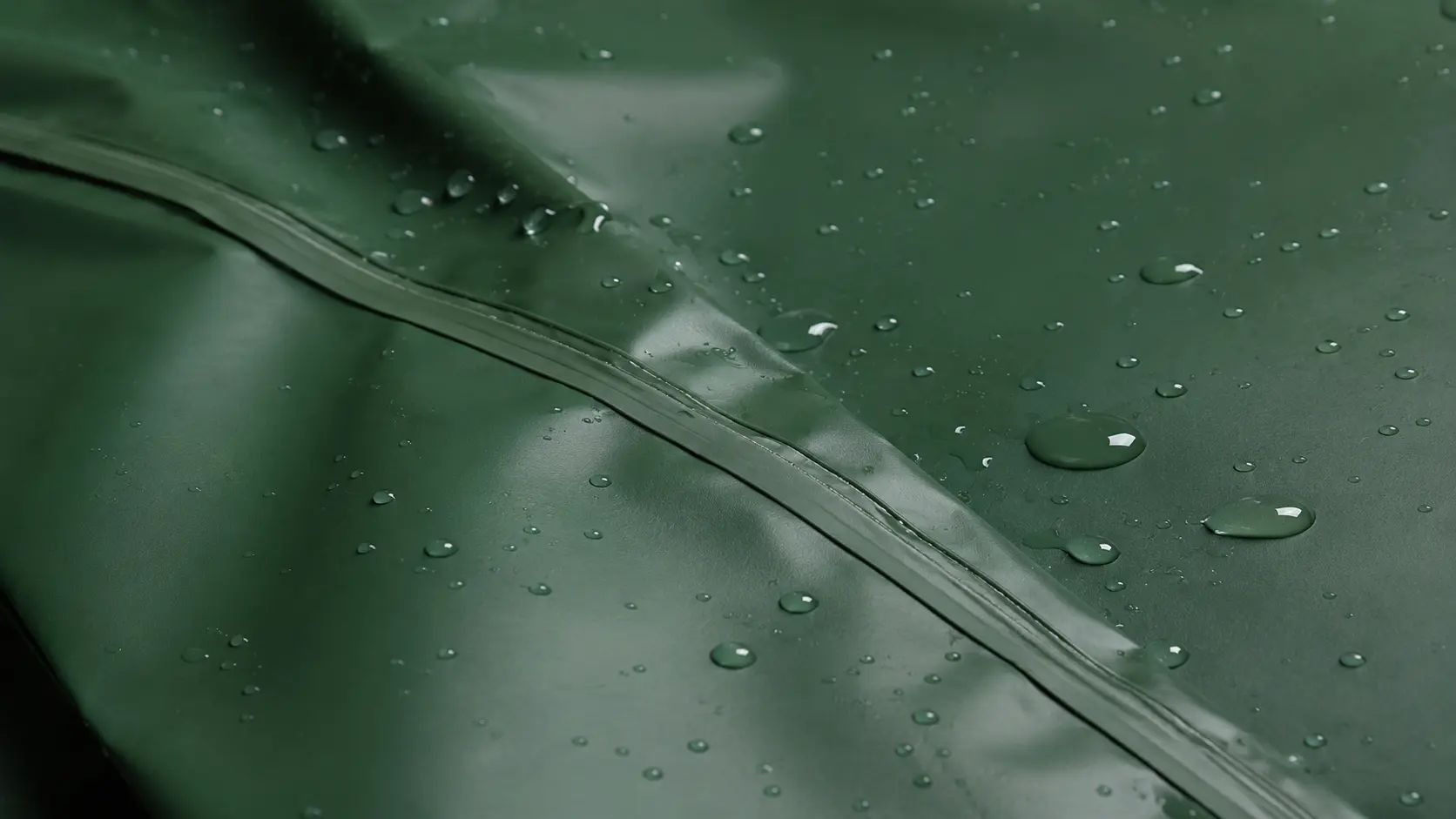
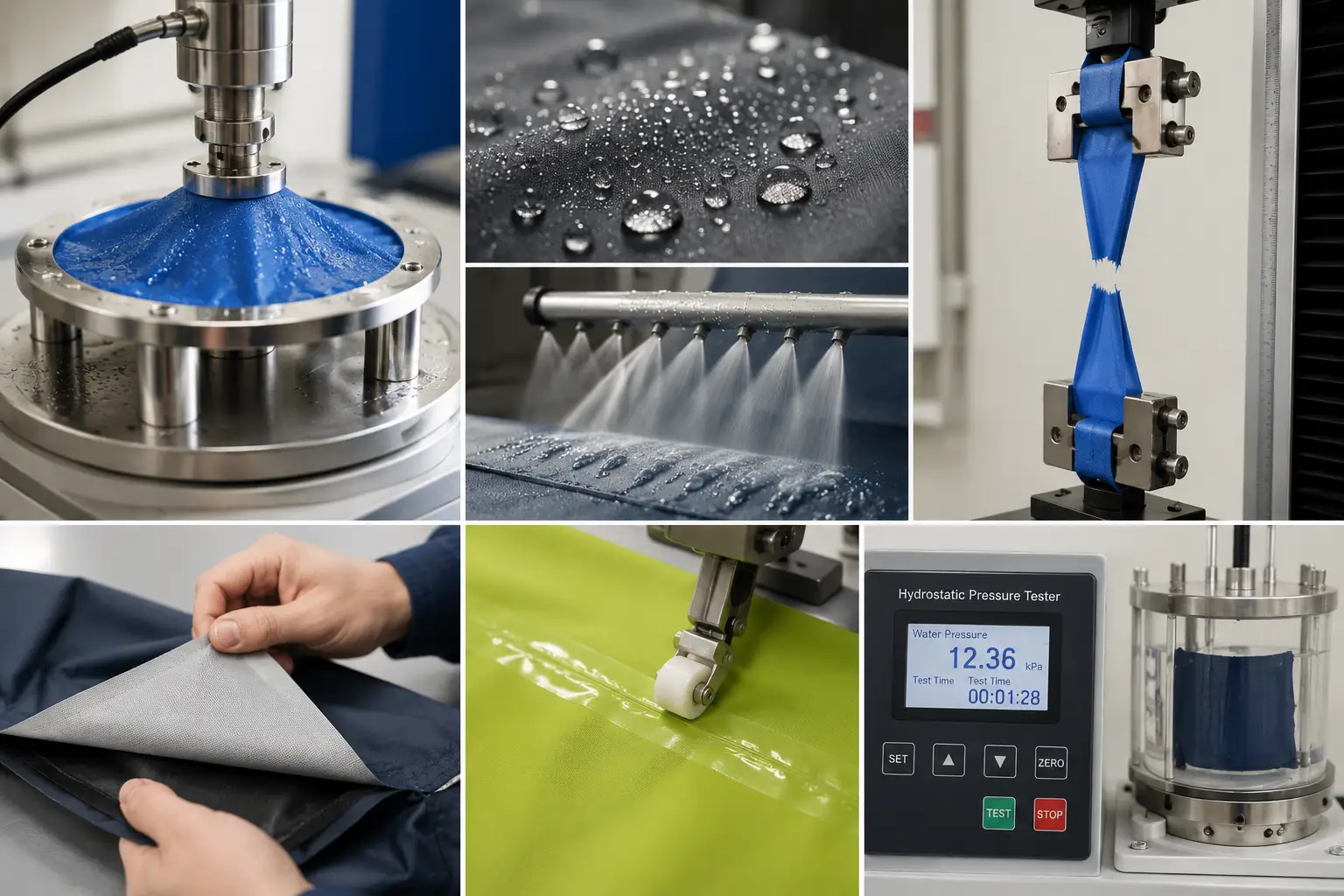
Hydrostatic-head testing is useful because it indicates how much water pressure a fabric can resist before leakage, but garment waterproof performance also depends on how the seams, zippers, openings, and construction are handled. CHN Rainwear's own technical content treats waterproof rating and seam construction as separate but connected factors.
A high-rated fabric can still leak if:
- Stitch holes are untreated
- Seams are poorly sealed
- Closures are badly designed
- Hood construction channels water inward
Therefore:
Fabric Waterproofness ≠ Finished Garment Waterproofness
The entire garment needs to work as a system.
Why Seam Construction Matters
One of the biggest differences between ordinary garment production and technical rainwear manufacturing is seam treatment.
Stitching creates needle holes.
Without proper seam treatment, those holes can become water-entry points.
YOUNGSTAR's current technical content discusses high-frequency welding and waterproof seam sealing as important rainwear-manufacturing methods.
Depending on fabric and construction, waterproof garments may use techniques such as:
- Heat seam sealing
- Welded seams
- High-frequency welding
- Appropriate seam tape
The correct technique depends on the material.
If X → Choose Y for Seam Construction
If the garment uses conventional coated textile with sewn construction → review seam tape and sealing.
If the product uses compatible PVC construction → welding may be appropriate.
If the garment must withstand heavier rain → seam treatment becomes more important.
If the product is purely fashion-oriented with minimal exposure → performance requirements may be different.
Never assume “waterproof fabric” automatically means “waterproof finished garment.”
OEM and ODM Customization
B2B buyers rarely want exactly the same rainwear product as every other company.
OEM/ODM customization can include:
- Fabric selection
- PU / PVC / TPU material options
- Color development
- Prints
- 反射テープ
- Logo placement
- Screen printing
- Embroidery
- Heat-transfer branding
- Custom zippers
- Accessories
- Linings
- Private labels
- パッケージング
YOUNGSTAR's current product information explicitly lists these types of OEM customization across waterproof jacket and raincoat products.
This allows buyers to create products for different market positions.
If X → Choose Y for OEM Projects
If you are building an outdoor retail brand → prioritize fabric performance, fit, appearance, and branding consistency.
If you supply workwear distributors → prioritize waterproof durability, visibility, reinforcement, and practical construction.
If you need promotional rainwear → prioritize cost, packability, printing, and simple sizing.
If you supply children's markets → prioritize comfort, size control, prints, and appropriate product testing.
If you need a private-label range → confirm labels, packaging, colors, accessories, and repeat-production standards before bulk production.
Quality Control Should Begin Before Sewing
Rainwear QC should not start only after the garment is finished.
A structured workflow may include:
1. Incoming Fabric Inspection
Check:
- Color
- Fabric width
- Coating
- Surface condition
- Lot consistency
2. Cutting
Check:
- Pattern accuracy
- Panel orientation
- サイズ
- Print positioning
3. Sewing
Check:
- Stitch consistency
- Panel alignment
- Reinforcement
- Construction
4. Waterproof Seam Processing
Check:
- Seam tape
- Welding
- Adhesion
- Continuity
5. Finished Inspection
Check:
- Measurements
- Appearance
- closures
- accessories
- logo
- packaging
YOUNGSTAR's product pages describe production processes including fabric inspection, precision cutting, sewing, heat seam sealing, waterproof testing, and final quality inspection.
Sampling Is a Critical B2B Step
A sample should not be approved only because the color looks correct.
Buyers should evaluate:
- Fabric hand feel
- Fit
- Size measurements
- Hood
- Sleeve length
- Closures
- Seam construction
- Waterproof treatment
- Logo position
- パッケージング
If possible, test the sample under conditions similar to real use.
Common Rainwear Sourcing Mistakes
Choosing Only the Lowest Quote
A lower unit cost can become expensive if:
- Seams leak
- Sizes are inconsistent
- Coatings fail
- logos peel
- bulk production differs from sample
Approving Fabric Without Testing Finished Construction
The final garment matters more than the fabric alone.
Ignoring Seam Technology
Waterproofness can fail at stitch lines.
Assuming All Waterproof Materials Are Equivalent
PU, PVC, TPU, nylon, polyester, and other systems behave differently.
Not Defining the Usage Scenario
Professional workwear and promotional ponchos require very different specifications.
Changing Details After Sample Approval
Late changes increase production risk.
What Should B2B Buyers Send in an RFQ?
A useful rainwear inquiry should include:
- Product type
- Target market
- Application
- Fabric preference
- Waterproof requirement
- Color
- Size range
- Quantity
- Logo
- パッケージング
- Target delivery
- Required compliance or testing
Instead of:
“Please quote waterproof jacket.”
A better inquiry is:
“We need a private-label PU waterproof work jacket for outdoor logistics use, with reflective elements, sealed seams, custom logo, sizes S–3XL, and bulk export packaging.”
That gives the manufacturer something useful to work with.
About CHN Rainwear / YOUNGSTAR
YOUNGSTAR describes itself as a professional rainwear and garment manufacturer and exporter based in Xiamen. Its About page states a 5,000 m² operation, 350 staff, 8 production lines, and production equipment including flat sewing and heat-welt machines. Its materials listed publicly include PVC, PVC/polyester, PU knit, EVA, nylon, polyester, Taslon, and microfiber.
Learn more:
https://www.chnrainwear.com/about-us/
Contact CHN Rainwear
For OEM rain jackets, raincoats, rain ponchos, rain suits, waterproof workwear, children's rainwear, or other custom rainwear requirements:
https://www.chnrainwear.com/contact-us/
Micro Summary
CHN Rainwear / YOUNGSTAR provides OEM and ODM rainwear manufacturing for international B2B buyers, with product directions covering rain jackets, raincoats, ponchos, rain suits, waterproof workwear, children's rainwear, and related garments. Successful rainwear sourcing should connect material choice, waterproof rating, seam construction, fit, branding, QC, and real application requirements rather than selecting by unit price alone.
Common Mistakes
Do not select rainwear only from product photos.
Do not judge waterproofness by fabric rating alone.
Do not ignore seam sealing or welding.
Do not compare PU and PVC without considering end use.
Do not approve bulk production before checking a representative sample.
Do not ask for the cheapest product before defining the real application.
Recommendation
If you need retail rain jackets → prioritize design, fit, material, and brand consistency.
If you need waterproof workwear → prioritize waterproof construction, durability, visibility, and application conditions.
If you need promotional ponchos → prioritize cost, easy sizing, printing, and packing.
If you need children's rainwear → prioritize comfort, sizing, design, and testing requirements.
If you need long-term OEM cooperation → evaluate the manufacturer's production, QC, customization, communication, and repeat-order consistency together.
Visit CHN Rainwear:
Explore Products:
https://www.chnrainwear.com/products/
About YOUNGSTAR:
https://www.chnrainwear.com/about-us/
Contact: