Why PU vs PVC Rainwear Is a Real Procurement Decision
Many buyers begin a rainwear project with one simple question: “Should we choose PU or PVC?”
That question sounds reasonable, but it is not complete enough for serious B2B procurement.
A better question is: “Which material fits the user, the climate, the wearing time, the price range, the product category, and the market requirement?”
That is where PU vs PVC rainwear becomes a real procurement decision rather than a material preference. A raincoat is not only a waterproof shell. It is also a product that must feel acceptable to wear, survive transport and storage, meet the expected cost range, support branding, pass compliance review, and perform in real rain conditions.
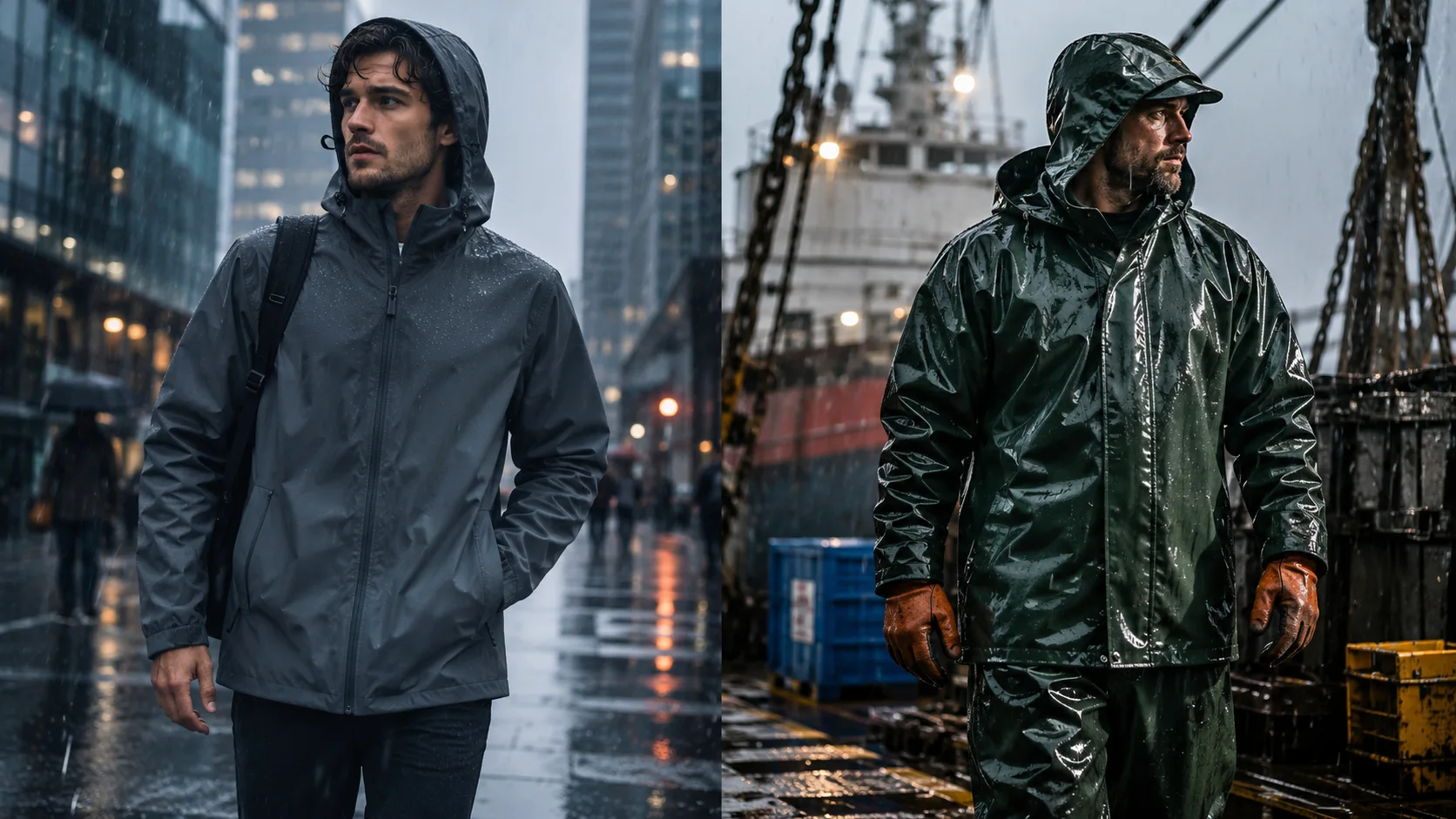
For example, a PVC rain poncho may be the most practical choice for a large outdoor event because it is waterproof, economical, easy to pack, and suitable for bulk orders. But the same PVC material may feel too stiff, heavy, or uncomfortable for a private-label city rain jacket sold in retail stores.
On the other hand, PU rainwear fabric may feel softer, lighter, and more apparel-like, making it attractive for urban rainwear, school raincoats, and branded waterproof jackets. But if a buyer uses a low-grade PU coating for harsh industrial workwear, the garment may face coating abrasion, hydrolysis, or reduced long-term durability.
This is why buyers should not treat PU and PVC as direct substitutes. They serve different product strategies.
In practical terms, PVC is often stronger when buyers need direct waterproof protection, low-to-medium cost, rugged use, or large-volume promotional production. PU is often stronger when buyers need better hand feel, lighter weight, softer wearing experience, and a more refined apparel appearance.
The wrong choice can create expensive consequences. Choosing PVC for the wrong retail product may lead to poor comfort, low perceived value, and weak repeat sales. Choosing PU for the wrong heavy-duty product may lead to coating failure, durability complaints, and replacement costs. Choosing either material without checking compliance can also create problems in Europe, North America, and brand-controlled supply chains.
When the application requires stronger waterproof protection, easy cleaning, and abrasion resistance, this guide to PVC coated polyester for industrial gear provides a deeper look at why double-coating matters in demanding work environments.
For importers, distributors, outdoor brands, uniform buyers, promotional product companies, and private-label rainwear buyers, the smartest approach is not to ask which material is universally better. The smarter approach is to match the material with the real use case.
What Is PU Rainwear Fabric?
Definition and Material Structure
PU rainwear fabric is usually made by applying polyurethane coating to a base textile such as polyester or nylon. The PU layer helps the fabric resist water penetration while keeping the material relatively soft, flexible, and wearable.
In many rainwear products, PU is used as a coating rather than a standalone fabric. The base fabric provides strength and structure, while the PU coating provides waterproof or water-resistant performance. Depending on the construction, PU-coated rainwear can be made for casual rain jackets, lightweight waterproof coats, school rainwear, fashion rainwear, travel rain jackets, and mid-range outdoor apparel.
The exact performance of PU coated rainwear fabric depends on several factors:
Fabric base
Fabric weight
PU coating thickness
Coating formulation
Waterproof rating
Breathability level
Coating adhesion
Aging resistance
Seam compatibility
Finished garment construction
This matters because not all PU rainwear is equal. A thin PU coating on low-density fabric may not perform like a higher-grade PU-coated polyester or nylon fabric designed for better waterproofness and durability.
For buyers, the key point is simple: PU usually improves comfort and garment-like appearance, but its performance still depends on fabric engineering and production quality.
Common Applications of PU Rainwear
PU rainwear is often used when the buyer wants a softer, lighter, and more wearable rainwear product. It is especially common in products where comfort, appearance, and retail value matter.
Common applications include:
Urban rain jackets
Lightweight waterproof jackets
School raincoats
Fashion rainwear
Packable travel rainwear
Private-label rain jackets
Mid-range outdoor rainwear
Soft workwear rain jackets
Children’s rainwear
For city rain jackets, PU-coated polyester can offer a good balance between waterproof protection and everyday comfort. For school rainwear, the softer hand feel can improve wearer acceptance. For private-label brands, PU can make the finished product look less like a plastic protective garment and more like normal apparel.
This is why PU raincoat manufacturer and custom PU rainwear supplier searches often come from buyers who are developing branded rainwear rather than basic disposable ponchos.
Advantages of PU Rainwear for B2B Buyers
The main advantage of PU rainwear is wearing comfort.
PU-coated fabric usually feels softer and more flexible than PVC-coated fabric. It can move more naturally with the body and feel closer to normal apparel. This is important for rain jackets that people wear during commuting, school, travel, or daily outdoor use.
For buyers selling through retail channels, touch and movement matter. Customers do not judge rainwear only by waterproof claims. They also notice whether the jacket feels stiff, noisy, heavy, or uncomfortable. A raincoat that feels too plastic-like may protect against rain, but it may still fail as a wearable product.
Another advantage is appearance. PU-coated fabrics can create a cleaner, more modern, and more textile-like surface. This helps when buyers want to develop rainwear that fits outdoor lifestyle, school use, commuting, uniform programs, or fashion-oriented markets.
PU also offers more flexibility in product design. It can work well with polyester and nylon base fabrics, support different colors, and be used in lightweight garment structures. In some constructions, PU-coated fabrics may also offer better breathability potential than traditional PVC materials.
For private-label buyers, PU can support better brand positioning. A rain jacket that feels soft and wearable is easier to position as a consumer product rather than a simple protective item.
This is why PU rainwear fabric is often a better option for:
Retail rain jackets
Private-label rainwear
Urban waterproof coats
School raincoats
Lightweight travel rainwear
Soft protective work jackets
Comfort-focused rainwear programs
Risks and Limitations of PU Rainwear
PU is not risk-free.
One of the most important risks is hydrolysis. Under humidity, heat, poor storage conditions, or low-quality coating formulation, PU coating may degrade over time. This can lead to stickiness, cracking, peeling, coating separation, or reduced waterproof performance.
For buyers, this risk is serious because the sample may look good at first. Problems may appear only after shipping, warehouse storage, folding, or long-distance transport. That is why buyers should ask about coating quality, aging resistance, storage conditions, and sample testing.
Another risk is abrasion. PU-coated fabrics can perform well, but low-quality PU coating may wear down under friction. This matters for workwear, backpacks, cycling, construction, logistics, and active outdoor use.
PU also does not automatically mean breathable. Some buyers assume PU rainwear is always breathable because it feels softer than PVC. That is not correct. Breathability depends on coating structure, fabric construction, membrane technology, and test performance.
B2B buyers should ask specific questions before ordering PU rainwear:
What is the base fabric?
What is the PU coating thickness?
What is the waterproof rating?
Has the coating been tested for adhesion?
Is the fabric hydrolysis-resistant?
Is it suitable for seam taping?
Can it support custom color and logo printing?
What storage conditions are recommended?
Can the supplier provide pre-production samples before bulk order?
PU is a good choice when buyers need comfort and appearance. But it must be controlled carefully to avoid coating-related problems.
What Is PVC Rainwear Fabric?
Definition and Material Structure
PVC rainwear fabric is usually made from polyvinyl chloride material, either as a coated fabric or a flexible waterproof sheet-like material. In coated constructions, PVC is applied onto a textile base such as polyester. In some rain ponchos or economical rainwear products, PVC-like film materials may be used directly.
PVC rainwear fabric is widely used because it provides strong waterproof performance, practical cost control, and stable mass production. It is especially common in rain ponchos, industrial rainwear, fishing rainwear, promotional raincoats, heavy-duty rain suits, and workwear raincoats.
PVC has a more protective and functional character than PU. It is often chosen when buyers want reliable rain blocking, easy cleaning, visible waterproof protection, and strong cost efficiency.
Like PU, PVC performance depends on specification. A lightweight PVC poncho is not the same as heavy-duty PVC-coated workwear fabric. Buyers need to check thickness, base fabric, flexibility, odor, low-temperature performance, welding suitability, color, and compliance requirements.
Common Applications of PVC Rainwear
PVC rainwear is widely used in practical rain protection products where waterproofness, cost, and durability matter more than softness.
Common applications include:
Rain ponchos
Promotional raincoats
Industrial rain suits
Fishing rainwear
Construction rainwear
Waterproof aprons
Heavy-duty workwear raincoats
Emergency rain protection
Outdoor event rainwear
Utility waterproof garments
PVC works well for products that need stronger physical waterproof protection. It can be used for high-visibility colors, glossy finishes, transparent rainwear, and utility-focused designs.
For large-volume orders, PVC raincoat factory and PVC coated rainwear material searches often come from buyers who need practical waterproof products at controlled cost. These buyers may include distributors, promotional product companies, workwear suppliers, outdoor event organizers, fishing supply brands, and industrial uniform buyers.
Advantages of PVC Rainwear for B2B Buyers
The biggest advantage of PVC rainwear is strong waterproof performance.
PVC naturally supports direct rain protection and can be used in thicker constructions for heavy-duty applications. For industrial rainwear, rain ponchos, and workwear rain suits, this is valuable because the product must block rain reliably in practical environments.
Another advantage is cost control. PVC is often more cost-efficient than higher-grade PU or laminated technical fabrics, especially for bulk orders. For promotional campaigns, emergency rainwear, event ponchos, and industrial supply programs, this can make PVC highly practical.
PVC also supports certain construction methods well, including welding and heat sealing in suitable applications. For some PVC rainwear products, welded seams can provide strong garment-level waterproof performance.
Durability is another benefit in the right context. PVC can handle rugged, utility-oriented use when the correct thickness and construction are selected. It is easy to clean, suitable for wet environments, and widely recognized in workwear and protective rainwear categories.
For buyers who need waterproof workwear raincoat fabric, PVC remains a strong option when comfort is not the only priority.
PVC can be especially suitable when the project requires:
Strong rain blocking
Heavy-duty appearance
Controlled bulk cost
Glossy or transparent styles
Industrial rain protection
Event ponchos
Fishing and outdoor utility rainwear
Easy cleaning and maintenance
Risks and Limitations of PVC Rainwear
PVC also has limitations that buyers should understand before placing bulk orders.
The first limitation is comfort. PVC usually feels heavier, firmer, and less breathable than PU. In active use, the wearer may feel hot or sweaty. This makes PVC less suitable for high-comfort rain jackets, cycling rainwear, hiking apparel, or premium retail rainwear.
The second limitation is hand feel. PVC often has a more plastic-like texture. This can be acceptable for industrial rainwear or ponchos, but it may reduce perceived value in fashion rainwear or private-label retail jackets.
The third limitation is compliance sensitivity. Depending on formulation, PVC may require closer attention to plasticizers, phthalates, pigments, heavy metals, odor, and restricted substances. This is especially important for children’s rainwear, European markets, branded retail channels, and institutional buyers.
The fourth limitation is temperature performance. Low-quality PVC may become less flexible in colder environments. If the rainwear is used in cold, wet, or outdoor working conditions, buyers should ask about low-temperature flexibility and cracking resistance.
For PVC orders, buyers should ask:
What is the PVC thickness or coating weight?
Is the material phthalate-free if required?
Does the material have strong odor?
Is it suitable for low-temperature use?
Can it support welding or heat sealing?
Is it suitable for industrial rainwear or workwear?
Can test reports be provided for the target market?
Can finished samples be approved before bulk production?
PVC is practical, strong, and cost-effective, but it must be matched carefully with market expectations and compliance requirements.
PU vs PVC Rainwear: Quick Technical Comparison Table
| Comparison Factor | PU Rainwear | PVC Rainwear | Buyer Takeaway |
|---|---|---|---|
| Material character | Softer, lighter, more apparel-like | Stronger, firmer, more protective | PU fits comfort-focused rainwear; PVC fits functional rainwear |
| Hand feel | Flexible and soft | More plastic-like and structured | PU usually feels better for retail jackets |
| Waterproofness | Good, depending on coating quality | Very strong, especially in thicker constructions | PVC is practical for heavy rain and workwear |
| Breathability | Better potential than PVC | Usually limited | PU is more suitable for wearable apparel |
| Weight | Usually lighter | Usually heavier | PU fits travel, school, and urban use |
| Durability | Depends on coating adhesion and hydrolysis resistance | Good for rugged and utility applications | PVC fits industrial and heavy-duty rainwear |
| Cost | Usually higher than basic PVC | Usually more cost-efficient | PVC helps control bulk order budgets |
| Appearance | More textile-like and modern | More functional or industrial | PU fits retail and private-label positioning |
| Seam method | Often stitched, taped, or sealed depending on fabric | Can support welded or heat-sealed constructions in suitable products | Seam method must match fabric structure |
| Compliance focus | Coating chemistry, hydrolysis, PFAS-free finishing if applicable | Plasticizers, phthalates, pigments, restricted substances | Both require market-specific review |
| Best use | Retail rain jackets, school rainwear, urban raincoats, private-label products | Ponchos, workwear, industrial rain suits, promotional rainwear | Choose by application, not by material name |
Performance Comparison Between PU and PVC Rainwear
Waterproof Performance: Which One Protects Better in Rain?
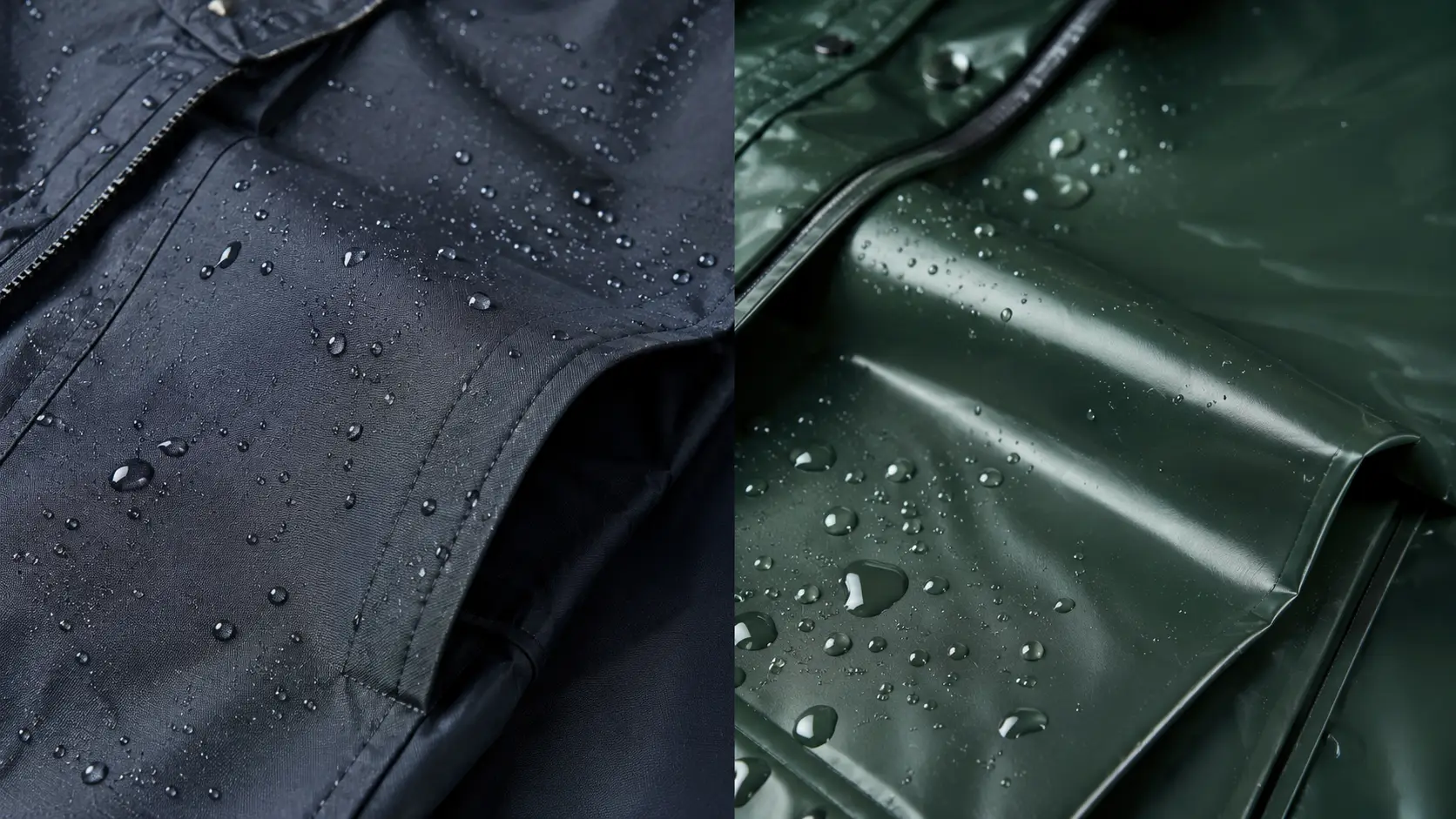
PVC usually has stronger direct waterproof performance, especially when used in thicker coated or sheet-like constructions. This is why PVC is common in ponchos, industrial rain suits, fishing rainwear, and heavy-duty workwear.
For simple rain blocking, PVC is often the more straightforward material.
PU can also provide good waterproof performance, but it depends more heavily on coating thickness, base fabric, coating quality, seam sealing, and garment construction. A high-quality PU-coated polyester rain jacket can perform very well in everyday rain. A low-quality PU coating, however, may not provide the same durability or long-term resistance.
This does not mean PVC always makes a better raincoat. It means PVC is usually stronger for direct water blocking, while PU is often better when the product also needs softness, lightness, and wearing comfort.
The finished garment must also be considered. A waterproof fabric can still leak through needle holes, zippers, pockets, cuffs, or poorly sealed seams. For both PU and PVC rainwear, seam construction is critical.
For heavy rain, outdoor work, fishing, or industrial use, buyers often lean toward PVC or heavy-duty coated fabrics. For daily commuting, school raincoats, retail jackets, and private-label lightweight rainwear, PU may provide enough waterproof performance with better user comfort.
Comfort and Breathability: Why PU Often Feels Better to Wear
Comfort is one of the biggest reasons buyers choose PU rainwear.
PU-coated fabric usually feels softer and more flexible than PVC. It can move more naturally with the body and feel closer to normal apparel. This is important for rain jackets that people wear during commuting, school, travel, or daily outdoor use.
PVC can protect well from rain, but it often traps heat and moisture inside the garment. During walking, cycling, or physical work, the wearer may become sweaty. In that situation, the user may feel wet even though rain is not entering from outside.
This is why comfort-focused buyers often prefer PU.
The market direction also supports this shift. Demand for waterproof-breathable textiles continues to grow because customers want rain protection without feeling trapped inside a plastic shell. The global waterproof-breathable textiles market was estimated at about USD 2.03 billion in 2024 and is projected to reach about USD 2.86 billion by 2030, with a forecast compound annual growth rate of about 5.9% from 2025 to 2030.
This does not mean every rainwear buyer needs premium waterproof-breathable fabric. But it does show that comfort is becoming a stronger purchasing factor, especially in outdoor, urban, cycling, school, and retail rainwear markets.
PVC still works well when comfort is less important than waterproof protection, cost control, or rugged use. But when the end user will wear the garment for longer periods, PU usually offers a better starting point.
Durability: Which Material Lasts Longer?
Durability depends on how the rainwear is used.
PVC is often more suitable for rugged waterproof applications. It can perform well in industrial environments, fishing, heavy rain, dirty conditions, and workwear use. It is easy to clean and can be made in thicker constructions. For rough use, PVC may provide stronger practical durability.
PU durability depends strongly on coating quality. A good PU-coated fabric can perform well in daily-use rain jackets, school rainwear, and private-label products. But low-quality PU can fail through coating peeling, hydrolysis, stickiness, or abrasion damage.
The key issue is not whether PU or PVC is always more durable. The key issue is whether the material is durable enough for the target use.
For a promotional poncho worn a few times, long-term durability may not be the top concern. For a retail jacket, the material should survive normal wearing, folding, storage, and light cleaning. For industrial rainwear, the garment must handle rougher use, friction, pulling, and exposure to wet working environments.
Buyers should ask for finished samples and inspect the following:
Coating adhesion
Fabric thickness
Tear strength
Abrasion resistance
Seam quality
Flexibility after folding
Odor after storage
Surface cracking or peeling
Performance after repeated handling
Durability is never proven by material name alone.
Weight and Packability: Which One Fits Travel and Retail Use Better?
PU rainwear usually has an advantage in lightweight and packable products.
Because PU-coated fabrics can be lighter and softer, they are often suitable for travel rain jackets, school raincoats, lightweight retail jackets, and compact rainwear. A lighter garment is easier to fold, pack, ship, and wear.
PVC rainwear is usually heavier, especially when the construction is designed for strong waterproof protection or industrial use. That weight can be useful for durability, but it is not ideal for every product.
For example, a heavy PVC raincoat may be practical for fishing or outdoor work, but it may not be attractive to a commuter who wants a light rain jacket in a backpack. A PU-coated polyester jacket may be better for that user.
Weight also affects shipping and packaging. For large B2B orders, heavier rainwear increases carton weight, storage space, and shipping considerations. Buyers should calculate not only fabric cost but also total logistics impact.
If the product needs to be compact, wearable, and retail-friendly, PU has a strong advantage. If the product needs to be protective, rugged, and utility-focused, PVC may be more practical.
Appearance and Brand Positioning
Appearance matters more than many B2B buyers admit.
For promotional rainwear, the product carries a logo. For retail rainwear, the product represents a brand. For school rainwear, parents and students care about comfort and style. For private-label rain jackets, the garment must look good enough to justify its market positioning.
PU usually looks more modern, softer, and more apparel-like. It can support matte finishes, cleaner surfaces, and better movement. This makes it suitable for private-label brands, uniform programs, school rainwear, and city rain jackets.
PVC often looks more functional, glossy, transparent, or industrial. That can be an advantage in the right category. A clear PVC poncho, high-visibility PVC raincoat, or heavy-duty PVC fishing rain suit does not need to look like a fashion jacket. It needs to look protective and practical.
The mistake is forcing one material into the wrong brand position.
If a buyer wants a premium-looking rain jacket, PVC may struggle unless the design intentionally uses a glossy or transparent style. If a buyer wants an economical industrial raincoat, PU may add cost without delivering enough value for that use case.
Brand positioning should guide material choice.
Cost Comparison: Why the Cheaper Material Is Not Always the Lower-Cost Choice
PVC usually offers stronger cost control, especially for bulk promotional raincoats, ponchos, and industrial rainwear. For buyers working with tight budgets, this makes PVC attractive.
PU usually costs more than basic PVC, especially when the buyer requires better hand feel, stronger coating stability, specific waterproof rating, softer base fabric, or better finish. However, PU can create higher perceived value in retail and private-label markets.
The lower material price is not always the lower total cost.
If a buyer uses PVC for a product that customers expect to be soft and wearable, returns and complaints may increase. If a buyer uses weak PU for rugged industrial workwear, replacement costs may increase. If compliance is not checked early, both PU and PVC can create expensive delays.
A useful way to think about cost is:
PVC may reduce initial material cost.
PU may improve user acceptance and retail value.
The wrong material increases after-sales cost.
The right material protects both margin and reputation.
For B2B procurement, the best material is not the cheapest material. The best material is the one that performs correctly for the product category and customer expectation.
Product-by-Product Selection Logic for PU vs PVC Rainwear
Material selection becomes much easier when buyers connect the fabric with the final product category. PU and PVC can both be good choices, but they are rarely good for the same reason.
A rain poncho, a workwear rain suit, a school raincoat, a private-label urban jacket, and a cycling rain shell may all belong to the rainwear category, but their performance requirements are very different. Some products need low cost and fast delivery. Some need comfort and better hand feel. Some need strong waterproof protection. Some need compliance documentation. Some need brand-friendly appearance.
That is why PU vs PVC rainwear should always be evaluated by application, not by material name alone.
Promotional Raincoats
Promotional raincoats are usually used for brand campaigns, corporate gifts, outdoor events, tourism programs, school activities, sports clubs, and supermarket promotions. In this category, buyers normally care about unit cost, logo printing, color consistency, packing method, and delivery time.
PVC is often a practical choice for promotional raincoats when the project is budget-sensitive and the product is intended for short-term or occasional use. It provides strong waterproof protection, supports large-volume production, and can be made in bright colors, glossy finishes, or transparent styles.
However, PU-coated polyester may be a better option when the promotional raincoat is expected to be worn repeatedly. If the buyer wants the recipient to actually keep and use the product, comfort and appearance become more important. A softer PU material can make the raincoat feel more like useful apparel rather than a one-time giveaway.
For promotional rainwear buyers, the safest approach is to match the material to campaign value. For low-cost public events, PVC can be enough. For branded corporate gifts or higher-value promotional apparel, PU may create better long-term brand exposure.
The main mistake is choosing the cheapest PVC material and expecting premium printing, soft wearing experience, and repeat use. That rarely ends well. A promotional raincoat is still a brand item. If it feels unpleasant, the logo travels straight into the storage drawer—or worse, the trash.
Industrial Workwear Raincoats
Industrial rainwear has a very different job. It must protect workers in wet, rough, and sometimes dirty environments. These products may be used in construction, road maintenance, logistics, fishing, sanitation, agriculture, utilities, ports, and outdoor facility operations.
For this category, PVC is often more suitable because it offers strong waterproof protection, rugged surface performance, easy cleaning, and practical cost control. Heavy-duty PVC rainwear can be especially useful for workers exposed to heavy rain, mud, water spray, or wet equipment.
A PVC raincoat factory may recommend thicker PVC-coated fabric or reinforced waterproof material for industrial use because durability and direct rain blocking matter more than soft hand feel. For industrial buyers, comfort is still important, but protection and service life usually come first.
PU can also be used in certain workwear raincoats, especially when the buyer needs a lighter and softer garment for long wearing hours. For example, a lightweight PU-coated waterproof work jacket may be better for workers who need mobility, moderate rain protection, and less stiffness.
The key is to understand the working environment. If workers face heavy rain, rough handling, and dirty conditions, PVC often makes more sense. If workers need a softer jacket for lighter-duty wet conditions, PU can be more comfortable.
For workwear orders, buyers should check fabric weight, coating thickness, seam method, reflective tape, hood design, zipper protection, cuff structure, size range, and cleaning requirements before confirming the material.
Retail Rain Jackets
Retail rain jackets require a stronger focus on comfort, appearance, and customer experience. The end user may compare the product with ordinary jackets, outdoor shells, or fashion rainwear. They will judge not only whether it blocks rain, but also whether it looks good, feels comfortable, and is easy to wear.
In this category, PU usually has an advantage.
PU rainwear fabric feels softer and more apparel-like than PVC. It is often more suitable for urban rain jackets, school raincoats, lightweight waterproof coats, and private-label rainwear. PU-coated polyester or nylon can create a cleaner appearance and better wearing comfort, especially for products sold through retail channels.
PVC can still be used for special styles, such as transparent raincoats, glossy fashion rainwear, or retro raincoat designs. But for general retail rain jackets, PVC may feel too stiff, heavy, or plastic-like unless the design intentionally uses that look.
For private-label buyers, product reviews matter. A rain jacket that looks good in photos but feels cheap in hand can damage the brand quickly. PU usually gives buyers more room to build a product that feels closer to normal apparel.
The main risk with PU retail rain jackets is coating quality. Buyers should not select PU only because it feels soft in the first sample. They should also check waterproof rating, coating adhesion, aging resistance, seam construction, color fastness, and storage stability.
Children’s Rainwear
Children’s rainwear requires extra care because parents care about softness, safety, odor, color, and comfort. Children also move actively, so the material must handle pulling, bending, sitting, folding, and frequent wear.
PU is often attractive for children’s rainwear because it can feel softer and less stiff. A soft PU-coated polyester raincoat may be more comfortable for school use, daily commuting, and outdoor play. It can also support colorful designs and a more friendly appearance.
PVC can also be used in children’s rainwear, especially for economical raincoats or certain waterproof styles, but buyers must pay close attention to odor, plasticizers, restricted substances, softness, and flexibility. This is especially important for Europe, North America, and markets with stricter children’s product expectations.
For children’s products, the decision should not be based only on cost. A material that smells strong, feels hard, or lacks compliance support can create serious problems. Parents are less forgiving than event poncho users. Tiny customers have big complaint power—usually through their parents.
Buyers should request finished samples, material composition, compliance information, color fastness checks, and packaging review before bulk production.
Rain Ponchos
For rain ponchos, PVC is usually more common than PU. PEVA and EVA are also widely used depending on product grade and target cost.
Rain ponchos are often used for outdoor events, travel, festivals, emergency kits, amusement parks, sports matches, and promotional campaigns. In these situations, buyers usually prioritize waterproof coverage, low unit cost, compact packaging, and fast production.
PU is generally not the most economical choice for basic ponchos. If the poncho is designed as a premium reusable product, then PU-coated polyester may be considered, but for most standard poncho orders, PVC, PEVA, or EVA remains more practical.
For buyers comparing rain poncho material wholesale options, the most important details include material thickness, softness, transparency, odor, packaging size, logo printing, carton quantity, and delivery schedule.
The key point is not to over-engineer the product. A one-time event poncho does not need the same fabric logic as a retail jacket. But it still needs to meet the buyer’s basic quality expectation.
Outdoor and Cycling Rainwear
Outdoor and cycling rainwear require better mobility, moisture control, and comfort. Users may move for long periods, sweat during activity, and expect the garment to protect against rain without feeling too hot or heavy.
PU-coated polyester or nylon is often more suitable than PVC in this category. For higher-performance rainwear, buyers may also consider TPU laminated fabric or waterproof-breathable membrane materials.
PVC is usually less suitable for active outdoor rainwear because it is heavier and less breathable. It can block rain effectively, but it may trap heat and sweat. For cyclists, hikers, and outdoor users, that can quickly become uncomfortable.
However, PU also has limits. Basic PU coating does not automatically make a fabric breathable or high-performance. If the product is positioned as technical outdoor apparel, buyers should ask for waterproof rating, breathability data, seam-taping compatibility, fabric weight, and finished garment testing.
For outdoor and cycling rainwear, the material should support movement, visibility, comfort, and packability. Reflective details, adjustable cuffs, longer back length, hood design, and seam sealing may matter as much as the fabric itself.
Compliance and Regulation Trends Affecting PU and PVC Rainwear
Rainwear buyers can no longer evaluate PU and PVC only by cost and waterproof performance. Chemical compliance, safer finishing, restricted substances, PFAS-related pressure, and sustainability requirements are becoming more important in global sourcing.
This is especially relevant for buyers selling into Europe, North America, children’s product channels, outdoor apparel markets, and private-label retail programs.
PFAS-Free Waterproof Apparel Is Becoming More Important
PFAS have historically been used in some water-repellent and stain-resistant textile treatments. Because of environmental persistence and regulatory concern, PFAS restrictions are becoming more important for textile and apparel buyers.
For PU and PVC rainwear, PFAS may not always be part of the base coating itself, but it can be relevant when the fabric uses water-repellent finishing, special surface treatment, or performance coating systems. Buyers should not assume a waterproof product is automatically PFAS-free.
France has moved ahead with PFAS-related restrictions affecting certain consumer products, including textiles and footwear. At the EU level, broader PFAS restriction discussions under REACH continue to influence how brands and importers evaluate waterproof materials.
For B2B buyers, the practical direction is clear: ask about PFAS-free options early. Do not wait until the final shipment stage. If the buyer’s customer requires PFAS-free documentation, the material route must be discussed before sampling and bulk production.
EU REACH and Chemical Compliance Pressure
EU REACH compliance remains important for rainwear buyers serving European markets. For PVC rainwear, buyers may need to pay particular attention to plasticizers, phthalates, heavy metals, pigments, stabilizers, and other restricted substances. For PU rainwear, coating chemistry, solvent residues, color fastness, and chemical safety may require review depending on product type and market.
This does not mean every order needs the highest possible certification. It means buyers should understand their target market before choosing material.
A budget rain poncho for a local outdoor event may not require the same documentation as a children’s raincoat sold through a European retail chain. A private-label outdoor jacket may require stronger material transparency than a simple emergency rainwear product.
Professional sourcing starts with the market requirement. Material selection should follow that requirement.
PVC-Related Buyer Concerns
PVC can be safe and practical when properly formulated and tested, but buyers should ask more detailed questions because PVC products can involve plasticizers and additives.
For PVC rainwear, buyers should check:
Phthalate-free requirements
Low-odor formulation
Restricted substance compliance
Lead-free pigment requirements
Heavy metal control
Low-temperature flexibility
Material thickness
Welding or heat-sealing suitability
Children’s product suitability
Target-market testing needs
These points matter more when the product is for children, retail, Europe, North America, or institutional procurement. If the product is a high-volume industrial rain suit, durability and waterproof strength may lead the selection, but chemical compliance should still be reviewed.
PU-Related Buyer Concerns
PU buyers should focus on coating stability and long-term performance.
For PU rainwear, buyers should check:
Hydrolysis resistance
Coating adhesion
Aging resistance
Abrasion performance
Waterproof rating
Breathability potential
Seam-taping compatibility
Color fastness
Storage condition requirements
PFAS-free finishing options if needed
The most common PU risk is approving a soft sample without testing long-term coating stability. A fabric may feel excellent at first but fail later through stickiness, peeling, or reduced waterproofness. For large orders, this is not a small issue. It can become a warehouse-level problem.
Compliance Checklist for PU and PVC Rainwear
| Compliance Item | PU Rainwear | PVC Rainwear | Buyer Action |
|---|---|---|---|
| PFAS-free requirement | Relevant if DWR or performance finishing is used | Relevant if surface treatment requires water or stain repellency | Ask for PFAS-free option and documentation if needed |
| REACH-related review | Check coating chemistry and restricted substances | Check plasticizers, pigments, stabilizers, and restricted substances | Confirm target-market requirements before sampling |
| Phthalates | Usually less central than PVC but still worth checking where required | Important concern for many PVC formulations | Request phthalate-free material if required |
| Heavy metals | Pigments and additives should be reviewed | Pigments and stabilizers should be reviewed | Ask for test reports when selling to regulated markets |
| Children’s products | Check softness, odor, color fastness, and chemical safety | Check odor, plasticizers, flexibility, and safety | Use stricter material review before bulk production |
| Durability testing | Focus on hydrolysis, coating adhesion, and abrasion | Focus on folding, cracking, odor, and low-temperature flexibility | Approve finished samples, not just fabric swatches |
Common Mistakes B2B Buyers Make When Comparing PU and PVC Rainwear
Material comparison should help buyers reduce risk. Unfortunately, many sourcing mistakes happen because buyers compare PU and PVC too simply.
Mistake 1: Assuming PU Is Always Better Because It Feels Softer
PU often feels softer and more comfortable than PVC, but that does not mean it is always the better choice.
For retail jackets, school rainwear, and private-label urban raincoats, PU can be excellent. But for heavy-duty industrial rain suits, fishing rainwear, rugged workwear, or low-cost ponchos, PVC may be more practical.
Softness is valuable only when the product category needs it. If the product needs rugged waterproof protection, PU may add cost without solving the main buyer problem.
Mistake 2: Assuming PVC Is Only Low-End
PVC is often associated with low-cost rainwear, but that view is too narrow.
PVC can be very useful in workwear, industrial rain protection, fishing rainwear, ponchos, emergency rainwear, and high-visibility protective garments. In these categories, the buyer may care more about waterproof strength, easy cleaning, welding compatibility, and durability than soft hand feel.
PVC becomes a poor choice only when it is forced into the wrong application, such as a premium lightweight retail rain jacket where comfort and appearance matter more.
Mistake 3: Comparing Prices Without Matching Specifications
Two suppliers may both quote “PU raincoat” or “PVC raincoat,” but the specifications may be completely different.
Fabric weight, coating thickness, base fabric, waterproof rating, seam method, printing method, packaging, MOQ, and compliance level can all change the price. A cheaper quotation may not be cheaper once the specifications are properly compared.
B2B buyers should compare quotations line by line. The correct question is not “Which supplier is cheaper?” The correct question is “Are these suppliers quoting the same product?”
Mistake 4: Ignoring Finished Garment Construction
A waterproof material does not automatically create a waterproof garment.
Both PU and PVC rainwear can fail if the finished product is poorly constructed. Stitched seams, zipper openings, pockets, cuffs, hoods, and printing areas can all affect final performance.
For rainwear, fabric and construction must be evaluated together. A buyer who approves only a fabric swatch may miss problems that appear only in the finished garment.
Before bulk production, buyers should approve a complete pre-production sample with the correct fabric, seam method, logo, accessories, packaging, and size.
Mistake 5: Checking Compliance Too Late
Compliance should be discussed before sampling, not after the goods are finished.
If a buyer needs PFAS-free finishing, phthalate-free PVC, REACH-related support, OEKO-TEX materials, or children’s product suitability, the supplier must know before material sourcing begins.
Late compliance checks can cause delays, material changes, re-sampling, failed delivery schedules, or even rejected orders. In regulated markets, “we will check later” is not a sourcing strategy. It is a future headache wearing a raincoat.
Mistake 6: Using One Material for Every Rainwear Category
Some buyers want to simplify sourcing by using the same material for every rainwear product. This may look efficient, but it can damage product performance.
A poncho, workwear rain suit, children’s raincoat, outdoor jacket, and retail raincoat should not use the same material logic. Each product has different needs.
The better approach is to build a material matrix by product category. PVC can lead for ponchos and industrial rainwear. PU can lead for urban, school, and private-label rain jackets. TPU or waterproof-breathable fabrics can be considered for higher-performance outdoor apparel.
Supplier Questions Before Ordering PU or PVC Rainwear
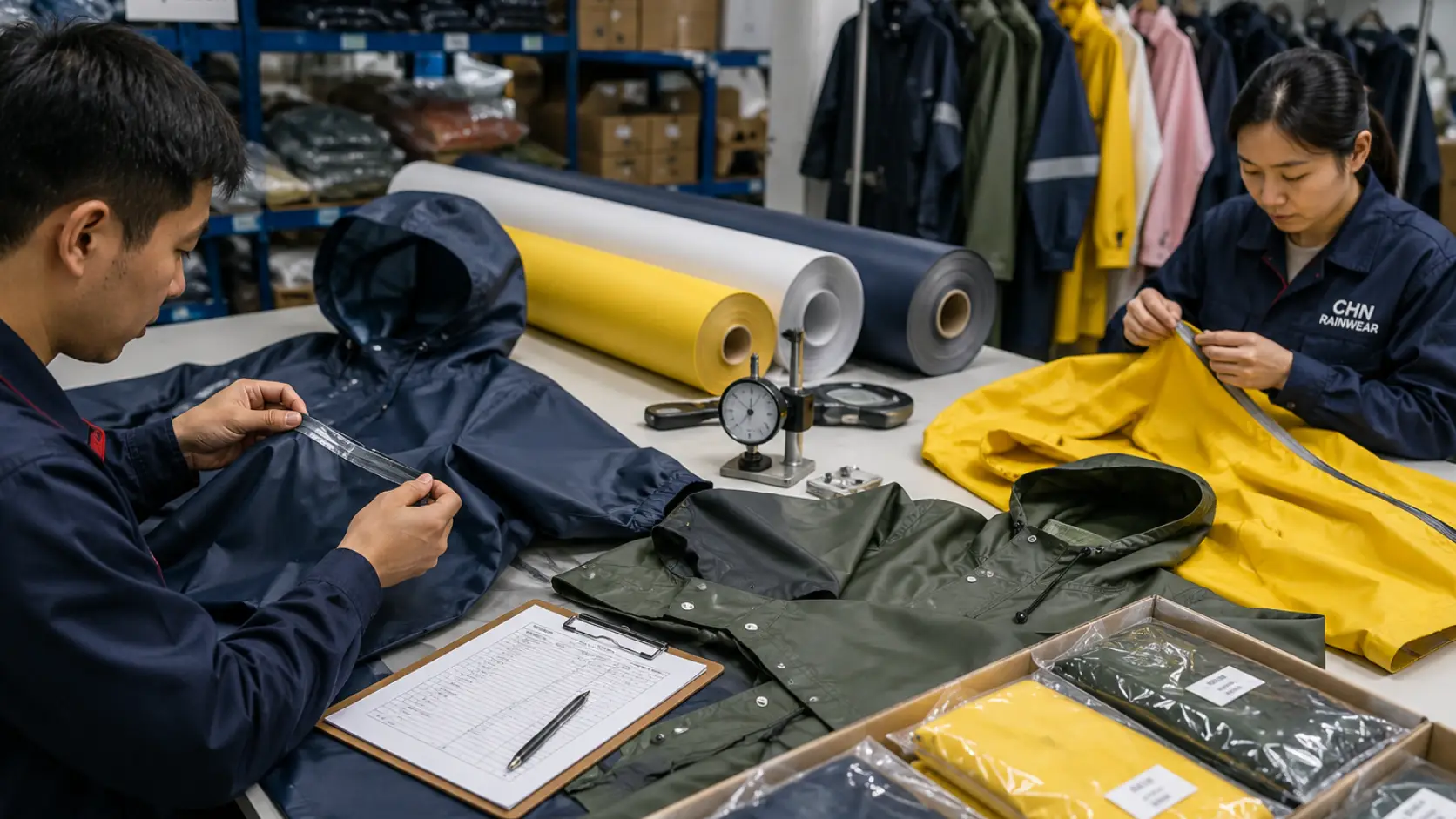
Before placing a bulk order, buyers should ask specific questions. Clear questions reduce misunderstanding, prevent wrong samples, and help suppliers recommend more suitable materials.
Questions for PU Rainwear
What is the base fabric: polyester, nylon, or another textile?
What is the fabric weight?
What is the PU coating thickness or coating structure?
What waterproof rating can the material achieve?
Is the coating hydrolysis-resistant?
Has coating adhesion been tested?
Can the fabric support seam taping?
Is the material suitable for custom colors?
Can the surface support logo printing?
Does the material have any recommended storage conditions?
Can PFAS-free finishing be arranged if required?
Can pre-production samples be made before bulk order?
Questions for PVC Rainwear
What is the PVC thickness or coating weight?
Is the material coated fabric or PVC sheet-like material?
Is the material phthalate-free if required?
Does the material have strong odor?
Is the material suitable for low-temperature use?
Can the material support welding or heat sealing?
Is it suitable for industrial or workwear applications?
Can it be made in transparent, glossy, or high-visibility colors?
Can the supplier provide restricted substance information if required?
Is the material suitable for children’s products if needed?
Can finished samples be approved before production?
Questions for Finished Rainwear Production
What seam method will be used?
Will the finished garment be tested for leakage?
Are the zipper areas protected?
Will the hood provide enough rain coverage?
Are cuffs adjustable or sealed?
Does the product need reflective tape?
Can the factory support logo printing or private-label packaging?
What is the MOQ by material, color, and size?
What is the sample lead time?
What is the bulk production lead time?
What quality checks are done before shipment?
Can the supplier provide production photos or inspection support?
A reliable rainwear fabric manufacturer or custom rainwear manufacturer should answer these questions clearly. If the answer is only “yes, no problem” without material details, buyers should be careful.
Recommended Decision Framework for B2B Buyers
The safest way to choose between PU and PVC is to start from product use, not material preference.
Choose PU when the product needs softer hand feel, lighter weight, better comfort, more apparel-like appearance, private-label positioning, school use, urban wear, or retail presentation. PU is often a better fit for rain jackets that people wear for longer periods or buy for daily use.
Choose PVC when the product needs strong waterproof protection, rugged performance, easy cleaning, cost control, industrial use, fishing use, rain poncho production, or promotional volume. PVC is often a better fit when the main value is practical rain blocking rather than premium wearing comfort.
Do not choose either material blindly when the product requires high breathability, technical outdoor performance, cycling use, or premium lightweight shell construction. In those cases, buyers may need to consider advanced PU constructions, TPU laminated fabrics, or waterproof-breathable membrane materials.
A good decision framework should include:
Target product category
Expected wearing time
Rain exposure level
Comfort expectation
Waterproof requirement
Durability requirement
Compliance requirement
Target market
MOQ and budget
Brand positioning
Production method
Inspection plan
When these details are clear, the PU vs PVC decision becomes much less confusing.
Why Work With a Professional Rainwear Manufacturer
A professional rainwear manufacturer should not simply ask whether the buyer wants PU or PVC. The supplier should first understand the product scenario.
A good factory should ask:
Who will wear the product?
Where will it be used?
How long will it be worn?
Is comfort more important or durability?
Is the product for retail, workwear, promotion, or private label?
What market will it be sold into?
Are compliance documents required?
What is the expected order quantity?
Does the buyer need custom color, logo, or packaging?
This matters because fabric selection is only one part of rainwear production. The final product also depends on pattern design, cutting, sewing, seam sealing, welding, printing, accessories, inspection, and packing.
CHN Rainwear can support buyers who need to compare PU and PVC rainwear options, develop samples, evaluate material choices, and produce raincoats, rain suits, ponchos, workwear rainwear, promotional rainwear, and private-label waterproof apparel.
For buyers who are unsure whether PU or PVC is the better route, the best starting point is not a quotation. It is a product requirement discussion. Once the use case is clear, the right material becomes easier to recommend.
Final Recommendation: PU and PVC Are Both Useful When Used Correctly
PU is not automatically premium. PVC is not automatically low-end.
Both materials are useful when used correctly.
PU is better for comfort-focused products, retail rain jackets, school rainwear, lightweight waterproof coats, and private-label designs where appearance and hand feel matter. PVC is better for strong waterproof protection, ponchos, industrial rainwear, fishing rainwear, promotional raincoats, and rugged workwear where direct rain blocking and cost control matter more.
The wrong decision usually happens when buyers focus on one factor only. Price alone is not enough. Softness alone is not enough. Waterproofness alone is not enough. The final decision should consider product use, user expectation, compliance requirements, garment construction, supplier capability, and long-term cost.
For B2B buyers, the best rainwear material is the one that fits the product’s real job.
Conclusion: Better Rainwear Starts With the Right Material Match
The comparison between PU vs PVC rainwear is not a battle between two materials. It is a sourcing decision based on application.
PVC gives buyers strong waterproof protection, cost efficiency, rugged use, and practical bulk production advantages. PU gives buyers softer hand feel, lighter construction, better wearing comfort, and stronger retail or private-label potential.
Neither material should be selected blindly. A rainwear buyer should first define the product category, target market, performance level, compliance needs, and budget range. Then the buyer can compare PU and PVC based on real procurement logic.
For a promotional poncho, PVC may be the smarter choice. For a soft city rain jacket, PU may be better. For industrial rainwear, PVC often leads. For school or private-label rainwear, PU often creates better user acceptance. For technical outdoor or cycling rainwear, buyers may need to go beyond basic PU and PVC and consider higher-performance material systems.
If you are developing rainwear for wholesale, workwear, promotional, retail, or private-label projects, CHN Rainwear can help compare PU and PVC options, prepare samples, and recommend a material route that fits your order requirements before bulk production.
よくあるご質問
1. Is PU or PVC better for rainwear?
PU and PVC are both suitable for rainwear, but they are better for different applications. PU rainwear is usually softer, lighter, and more suitable for retail rain jackets, school raincoats, urban rainwear, and private-label waterproof apparel. It is often selected when comfort, hand feel, and appearance matter. PVC rainwear is usually stronger in direct waterproof protection, cost control, rugged use, ponchos, industrial rain suits, fishing rainwear, and promotional raincoats. For B2B buyers, the better material depends on product use, target market, wearing time, waterproof requirement, comfort expectation, compliance needs, and budget. PU is not always better because it feels softer, and PVC is not always lower-value because it feels more functional. The right choice should match the product’s real application.
2. What is the main difference between PU and PVC rainwear?
The main difference is material character and product positioning. PU rainwear is usually made with polyurethane coating applied to polyester or nylon fabric. It tends to feel softer, lighter, and more apparel-like, making it suitable for comfort-focused rain jackets and private-label products. PVC rainwear uses polyvinyl chloride material or PVC-coated fabric. It usually offers stronger waterproof protection, a more structured feel, and better suitability for industrial rainwear, ponchos, promotional raincoats, and heavy-duty workwear. PU is often preferred for daily-use rain jackets, while PVC is often preferred for utility-focused waterproof protection. Buyers should also compare coating quality, fabric weight, seam method, compliance requirements, and finished garment construction before deciding.
3. Is PVC rainwear waterproof?
Yes, PVC rainwear is generally waterproof and is widely used in products that require strong rain protection. PVC-coated fabric or flexible PVC material can block water effectively, which makes it suitable for rain ponchos, industrial rain suits, fishing rainwear, promotional raincoats, and heavy-duty waterproof workwear. However, finished garment waterproofness depends not only on the PVC material but also on seam construction, zipper protection, welding, heat sealing, cuffs, hood design, and quality inspection. A PVC fabric may resist water well, but the garment can still leak if the seams are poorly made. Buyers should confirm fabric thickness, waterproof performance, seam method, odor control, flexibility, and compliance before placing bulk PVC rainwear orders.
4. Is PU rainwear breathable?
PU rainwear can have better breathability potential than PVC rainwear, but PU is not automatically breathable. Breathability depends on the coating structure, base fabric, membrane technology, fabric construction, and test performance. Some PU-coated fabrics are designed mainly for basic waterproof protection and may still feel warm during active use. Higher-grade PU constructions may offer better comfort and moisture management, especially when used in lightweight rain jackets, urban rainwear, or outdoor apparel. Buyers should not assume that a soft PU fabric is breathable without data. For active outdoor, cycling, or hiking rainwear, buyers should ask for waterproof rating, breathability information, seam-taping compatibility, and finished garment testing before approving the material.
5. Which material is better for workwear raincoats?
PVC is often better for heavy-duty workwear raincoats because it provides strong waterproof protection, rugged surface performance, easy cleaning, and practical cost control. It is commonly used in construction, fishing, sanitation, logistics, agriculture, and other wet working environments. However, PU can be suitable for lighter workwear rain jackets when comfort, mobility, and longer wearing time are important. For workwear buyers, the best material depends on the working environment. Heavy rain, mud, rough handling, and industrial use usually point toward PVC or reinforced waterproof materials. Moderate rain, lighter work conditions, and comfort-focused uniform programs may benefit from PU-coated fabric. Buyers should also check seam strength, reflective tape, zipper protection, fabric weight, and compliance requirements.
6. Which material is better for private-label rain jackets?
PU is usually better for private-label rain jackets because it offers softer hand feel, lighter weight, better appearance, and a more apparel-like wearing experience. Private-label buyers often need products that look attractive, feel comfortable, and support brand positioning. PU-coated polyester or nylon can help create rain jackets suitable for urban commuting, school use, travel, and retail channels. PVC can still be used for special private-label styles, such as transparent raincoats, glossy rainwear, or utility-inspired designs, but it may feel too stiff or plastic-like for general retail jackets. Before ordering, buyers should confirm waterproof rating, coating stability, color consistency, seam construction, logo method, packaging, and compliance needs.
7. What should buyers ask a rainwear manufacturer before ordering PU or PVC rainwear?
Before ordering PU or PVC rainwear, buyers should ask about the base fabric, coating type, fabric weight, waterproof rating, seam method, MOQ, sample lead time, bulk production lead time, logo options, packaging, and quality control process. For PU rainwear, buyers should ask about hydrolysis resistance, coating adhesion, breathability potential, storage conditions, and seam-taping suitability. For PVC rainwear, buyers should ask about material thickness, phthalate-free options, odor, low-temperature flexibility, welding suitability, and restricted substance compliance. Buyers should also approve a finished pre-production sample before bulk production. A professional rainwear manufacturer should explain which material fits the product application instead of simply offering the lowest price.
References
- Waterproof Breathable Textiles Market Size Report, 2030
Author/Organization: Grand View Research
Source: Grand View Research - Waterproof Breathable Textiles Market Size & Share Analysis
Author/Organization: Mordor Intelligence
Source: Mordor Intelligence - France Publishes Updated PFAS Regulation for Consumer Products
Author/Organization: SGS
Source: SGS Safeguards - ECHA Consults Over SEAC’s Draft Opinion on PFAS Restrictions Under REACH
Author/Organization: SGS
Source: SGS Safeguards - ECHA Launches Public Consultation on PFAS Restriction Proposal
Author/Organization: CIRS Group
Source: CIRS Group - What France’s Ban on Forever Chemicals Means for Fashion
Author/Organization: Emily Chan
Source: Vogue - PFAS in Textiles: Bans, Health Risks, and Safer Alternatives
Author/Organization: bluesign Technologies
Source: bluesign - OEKO-TEX Standard 100: Product Class and Textile Safety Criteria
Author/Organization: OEKO-TEX Association
Source: OEKO-TEX
PU and PVC Rainwear Selection Insights for B2B Procurement
What is the core difference between PU and PVC rainwear? PU rainwear is usually built around polyurethane-coated fabric, often applied to polyester or nylon to create a softer, lighter, and more apparel-like rainwear material. PVC rainwear is usually based on polyvinyl chloride coating or flexible waterproof PVC material, offering stronger direct waterproof protection, more rugged surface performance, and better cost control for high-volume or heavy-duty applications. The choice is not about which material is universally better; it is about which material fits the product’s real use.
How should B2B buyers choose between PU and PVC rainwear? Buyers should begin with the final product scenario. For retail rain jackets, school raincoats, lightweight waterproof coats, and private-label rainwear, PU is often the stronger option because comfort, hand feel, and appearance matter. For promotional raincoats, rain ponchos, industrial rain suits, fishing rainwear, and rugged workwear, PVC is often more practical because waterproof strength, easy cleaning, and cost control are usually more important than softness.
Why does waterproof performance alone not decide the material? PVC may offer stronger direct rain blocking, especially in thicker coated or sheet-like constructions, but a waterproof fabric does not automatically create a waterproof garment. Finished rainwear can still fail through stitched seams, zippers, pockets, cuffs, hoods, poor welding, weak coating adhesion, or unsuitable accessories. For both PU and PVC rainwear, buyers should evaluate fabric waterproofness together with seam construction, finished sample testing, coating stability, and real wearing conditions.
What options should buyers compare before placing a PU or PVC rainwear order? Buyers should compare base fabric, coating thickness, fabric weight, waterproof rating, breathability potential, hand feel, color options, logo printing method, seam sealing or welding method, MOQ, sample lead time, bulk lead time, packaging, and compliance documentation. A professional rainwear manufacturer should explain why a specific PU or PVC material fits the buyer’s product instead of only offering the lowest quotation.
What compliance trends are changing PU and PVC rainwear sourcing? International buyers are paying more attention to PFAS-free waterproof finishing, REACH-related restricted substances, phthalate-free PVC options, coating chemistry, color fastness, heavy metal control, and children’s product safety. For European, North American, outdoor apparel, private-label, and children’s rainwear markets, compliance should be discussed before sampling. Waiting until bulk production is finished can lead to re-sampling, shipment delays, or rejected orders.
Which sourcing decision is usually safest? Choose PU when the product needs a softer hand feel, lighter construction, better comfort, retail appearance, school use, urban wear, or private-label positioning. Choose PVC when the product needs strong waterproof protection, rugged use, easy cleaning, cost control, promotional volume, poncho production, industrial use, or fishing rainwear. If the product requires high breathability, cycling use, hiking performance, or premium outdoor positioning, buyers may need to compare advanced PU constructions, TPU laminated fabrics, or waterproof-breathable membranes rather than relying only on basic PU or PVC.
Practical recommendation: Before confirming a wholesale rainwear order, buyers should approve a finished pre-production sample, not only a fabric swatch. The sample should confirm fabric structure, waterproof rating, seam method, coating stability, odor, hand feel, logo effect, packaging, compliance needs, and real garment performance. CHN Rainwear can support buyers with PU and PVC rainwear comparison, material selection, sample development, custom rainwear manufacturing, and B2B procurement planning for promotional, retail, workwear, outdoor, and private-label projects.