Why Waterproof Rating Matters in Rainwear Procurement
Many buyers see the word “waterproof” and assume the product will protect users in real rain. A common sourcing problem looks like this: a buyer confirms an 8,000mm waterproof fabric, approves the sample, and expects the finished rain jacket to perform well in field use. But after delivery, users report leakage around the shoulders, zipper area, or pocket seams. The problem is not always the fabric rating. In many cases, the fabric performs correctly, but the finished garment does not. This is why B2B buyers should treat Waterproof Rating as one part of the full rainwear performance system, not as a single purchasing shortcut.That assumption is risky.
In rainwear sourcing, “waterproof” is only a starting point. The real question is how waterproof the fabric is, how that waterproofness was tested, whether the seams are sealed, whether the zippers are protected, whether the coating can survive use and storage, and whether the finished garment can perform beyond a fabric sample.
Buyers who are still comparing PVC, PU, TPU, polyester, nylon, PEVA, and breathable materials can also review our Rainwear Fabrics buying guide before selecting a waterproof rating.
This is where Waterproof Rating becomes important.
A waterproof rating helps buyers compare how much water pressure a fabric can withstand before leakage. It is commonly expressed in millimeters, such as 3000mm, 5000mm, 8000mm, 10000mm, or 20000mm. These numbers are often linked to hydrostatic head testing, a standard way to evaluate water penetration resistance in textiles.
But buyers should not treat waterproof rating as a magic number.
A fabric may test well in the lab, but the finished raincoat can still leak through stitched seams, zipper openings, pocket edges, cuffs, hood seams, or poorly sealed construction. A 10000mm-rated fabric may still fail as a rain jacket if the garment design is weak. A 5000mm fabric may perform well for daily rainwear if the product is properly designed and used in the right conditions.
This is why rainwear waterproof rating should be considered together with fabric type, coating quality, seam sealing, breathability, and end-use scenario.
For a promotional raincoat, the buyer may not need very high hydrostatic head performance. For a daily rain jacket, moderate waterproof protection may be enough if comfort and fit are good. For workwear raincoats or cycling rainwear, higher performance and better seam construction become more important. For high-end outdoor shells, waterproof rating must also work together with breathability and long-term durability.
In short, waterproof rating is not just a technical number. It is a purchasing decision.
The wrong rating can cause two kinds of problems. If the rating is too low, the product may leak, create complaints, and damage brand trust. If the rating is unnecessarily high, the buyer may pay more, reduce comfort, increase fabric stiffness, or overbuild a product that does not need premium specifications.
For B2B buyers, the smartest approach is not to ask for the highest number. It is to ask for the right number.
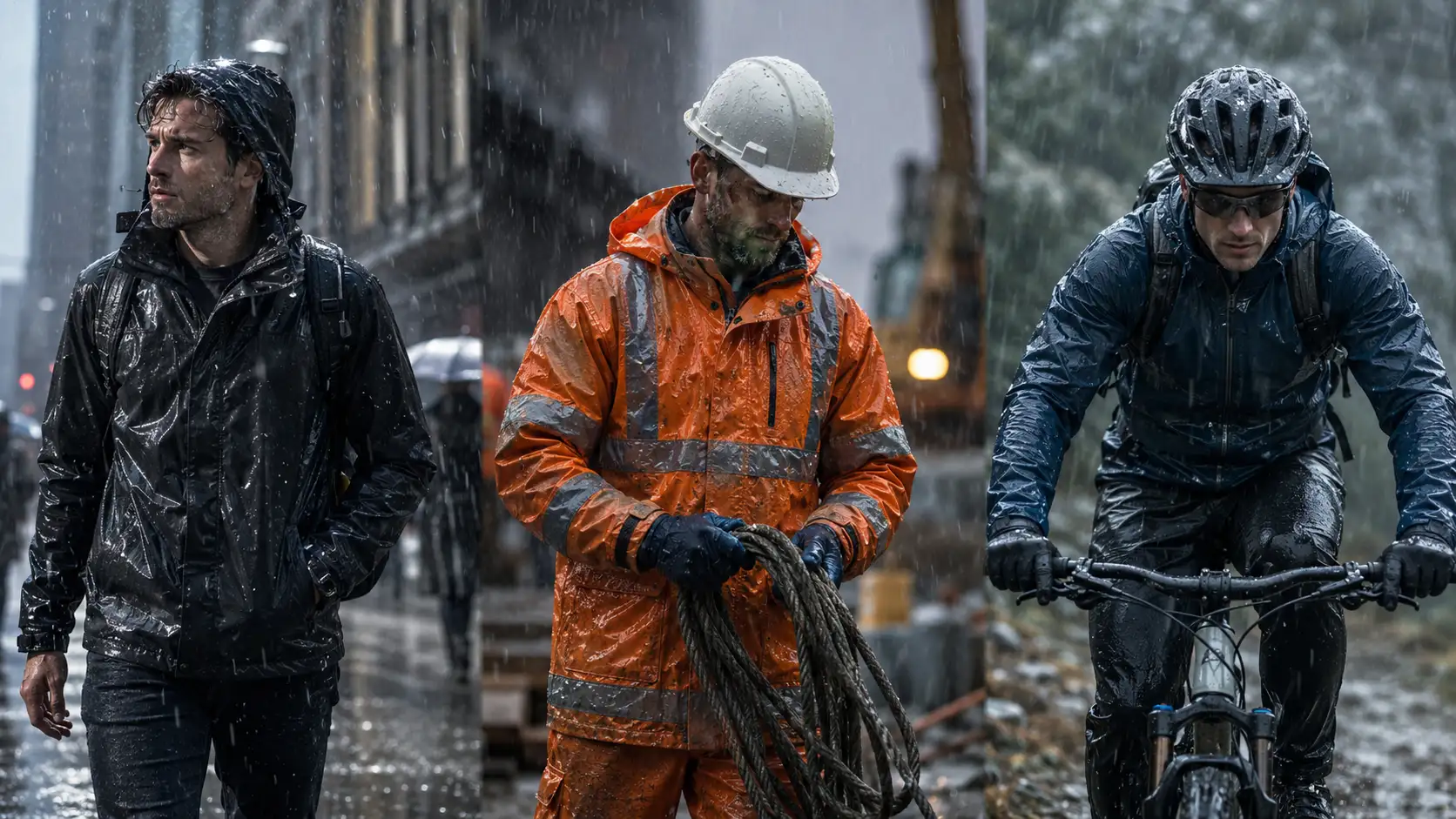
What Does Waterproof Rating Mean?
Definition for Rainwear Buyers
Waterproof Rating describes the ability of a fabric to resist water pressure before water passes through the material. In rainwear production, it is one of the most common indicators used to compare waterproof fabrics, coated fabrics, laminated fabrics, and finished rainwear materials.
The rating is usually shown in millimeters. For example, a fabric may be listed as 3000mm, 5000mm, 8000mm, 10000mm, or 20000mm waterproof. These values are connected to hydrostatic head testing, where water pressure is applied to a fabric sample until water penetration occurs.
For buyers, a higher number generally means stronger resistance to water pressure. However, the value must be interpreted correctly.
When buyers are unsure whether PU or PVC is more suitable for the target product, this PU vs PVC rainwear comparison can help clarify comfort, waterproof performance, durability, and sourcing risk.
A 3000mm waterproof rating may be suitable for light rain or short-use rainwear. A 5000mm to 8000mm rating may be suitable for many daily rain jackets, school raincoats, and urban rainwear products. An 8000mm to 10000mm rating may be more appropriate for workwear, longer rain exposure, or heavier-duty rainwear. A 10000mm or higher rating may be needed for outdoor, cycling, hiking, or more technical waterproof apparel.
But the number alone does not define the final product.
Waterproof rating usually evaluates the fabric, not the entire rainwear garment. Once the fabric is cut and sewn, water can enter through seams, zippers, pockets, stitching holes, cuffs, and poorly designed hoods. This is why waterproof fabric testing and finished garment evaluation should be treated as two related but different steps.
Why Waterproof Rating Is Usually Measured in Millimeters
Waterproof rating is often expressed as the height of a water column that the fabric can withstand before leaking. This is known as hydrostatic head.
For example, a 5000mm waterproof rating means the fabric can resist water pressure equivalent to a water column of approximately 5000 millimeters before water begins to penetrate under test conditions. A 10000mm rating means the fabric can resist a higher water pressure.
This does not mean that rainwater literally piles up five or ten meters above the garment in real life. The number is a controlled test value that helps compare fabric performance.
In real use, water pressure can come from different situations:
Heavy rain hitting the fabric
Sitting on wet surfaces
Kneeling on wet ground
Backpack straps pressing water into the shoulder area
Wind-driven rain
Folding and creasing points
Workers leaning against wet equipment
Cyclists facing rain at speed
This is why hydrostatic head values matter. They do not only represent rain falling from the sky. They also help buyers understand how fabric may perform when water pressure increases because of movement, weight, or contact with wet surfaces.
Why Waterproof Rating Is Not the Same as Real Garment Waterproofness
This is one of the most important points for B2B buyers.
A high Waterproof Rating does not automatically mean the finished raincoat is fully waterproof.
The rating is often based on a fabric sample. But a finished rainwear product includes many other construction details. These details can either protect the garment from leakage or create weak points.
Finished rainwear waterproofness depends on:
Fabric waterproof rating
Coating or membrane quality
Seam taping or seam sealing
Heat-sealed or welded construction
Zipper protection
Storm flap design
Pocket structure
Hood coverage
Cuff adjustment
Hem design
Garment fit
Washing and aging resistance
Quality control during production
A buyer may order a fabric with an 8000mm waterproof rating, but if the seams are stitched without sealing, rain may enter through the needle holes. A jacket may use strong waterproof material, but if the zipper has no storm flap, water may enter through the front opening. A workwear raincoat may have good fabric, but if the hood is too shallow, the user may still get wet.
That is why rainwear manufacturer waterproof testing should include both material review and finished sample review.
The practical rule is simple: waterproof rating tells you how the fabric performs; garment construction tells you whether the rainwear product can actually protect the wearer.
Waterproof rating is only one part of material selection; for industrial rainwear, PVC coated polyester industrial gear also requires abrasion resistance, coating adhesion, seam compatibility, and long-term surface durability.
What Is Hydrostatic Head?
Simple Explanation
Hydrostatic head is a test measurement used to evaluate the resistance of a fabric to water penetration under pressure. It is one of the most common ways to describe waterproof performance in rainwear fabrics and waterproof textiles.
In simple terms, hydrostatic head answers this question:
How much water pressure can the fabric resist before water starts to pass through?
The result is usually expressed in millimeters. A higher value generally means the fabric can resist more water pressure.
For rainwear buyers, hydrostatic head for rainwear is useful because it provides a more specific performance indicator than general words such as waterproof, water-resistant, or rainproof.
However, hydrostatic head should not be treated as the only buying standard. It does not fully describe breathability, softness, tear strength, coating durability, seam sealing, chemical compliance, or finished garment comfort.
How Hydrostatic Head Testing Works
Hydrostatic head testing typically involves clamping a fabric sample under controlled conditions and applying water pressure to one side of the fabric. The pressure gradually increases until water droplets appear on the opposite side. The pressure level at which water penetration occurs is recorded as the hydrostatic head value.
In many laboratory methods, the test focuses on resistance to water penetration under increasing hydrostatic pressure. The fabric is tested as a material sample, which helps buyers compare different fabrics before garment production.
This is useful because rainwear fabrics can look similar but perform very differently. Two coated polyester fabrics may both appear waterproof by touch, but one may start leaking at a much lower pressure than the other. Without testing, buyers may not discover the difference until after bulk production.
Hydrostatic head testing helps buyers avoid vague claims such as “very waterproof” or “good quality waterproof fabric.” Instead, it gives a measurable value.
For B2B procurement, this value becomes especially important when comparing supplier quotations. A supplier quoting a 3000mm fabric cannot be compared directly with another supplier quoting an 8000mm fabric unless the buyer understands the performance difference.
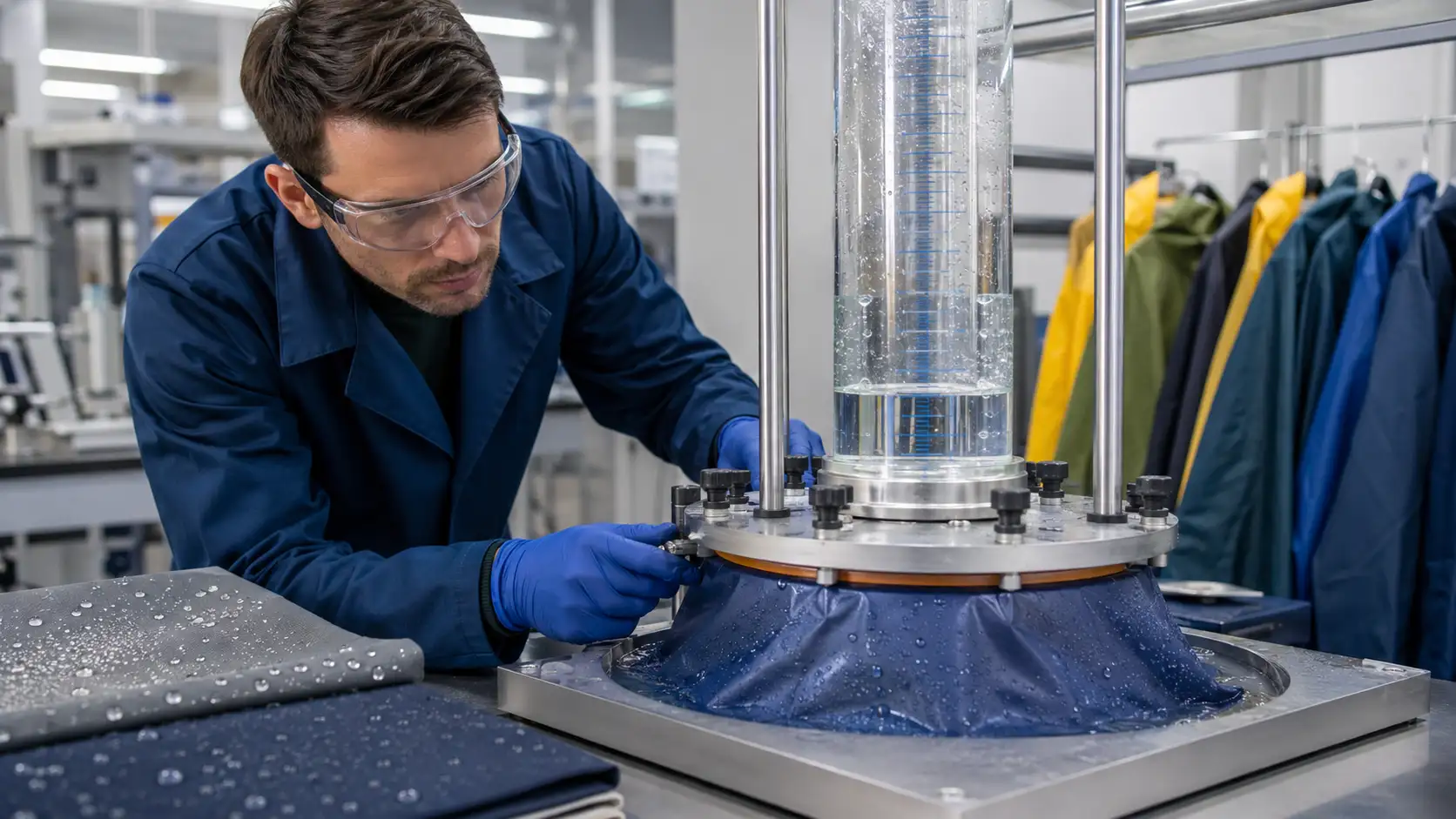
Common Hydrostatic Head Test Standards
Several test standards are used in the textile industry to measure resistance to water penetration. Common references include:
ISO 811
AATCC 127
EN 20811
JIS L 1092
These methods may vary in equipment, procedure, pressure increase rate, test conditions, and result interpretation. For buyers, the exact standard matters because waterproof rating values are most useful when the test method is clear.
A professional rainwear factory China or waterproof garment supplier should be able to explain how the waterproof rating was measured. If a supplier only says “5000mm waterproof” but cannot explain the test method, sample condition, or whether the value applies to fabric or finished garment, the buyer should ask more questions.
For large orders, test consistency is important. Buyers should confirm whether the value is based on internal testing, third-party testing, pre-production fabric testing, or finished garment testing.
Why Test Method Consistency Matters
Waterproof ratings should be compared carefully because test conditions can affect results.
A fabric tested under one method may not be directly comparable to a fabric tested under another method. Even when the same method is used, results can vary depending on sample preparation, coating condition, fabric aging, pressure increase rate, and whether the fabric has been washed, folded, or abraded.
For example, a new coated fabric may perform well before washing or folding. But after repeated folding, packing, or storage, coating cracks or weakness may reduce performance. A fabric may pass a basic test as a flat sample, but the finished garment may still leak at seams or stress points.
For serious rainwear B2B procurement, buyers should ask:
Which test method was used?
Was the fabric tested before or after washing?
Was the value tested by the factory or a third-party lab?
Does the rating apply to fabric only or finished garment?
Was the fabric tested after coating aging or folding?
Can the factory test pre-production samples before bulk production?
These questions are not excessive. They are part of professional waterproof rainwear sourcing.
Waterproof Rating Levels: What Do 3000mm, 5000mm, 8000mm, and 10000mm Mean?
Quick Waterproof Rating Table for Rainwear Buyers
The following table gives a practical reference for buyers. Exact requirements may vary depending on market, fabric type, seam construction, product design, and customer expectation.
| Waterproof Rating | Typical Meaning | Suitable Rainwear Use | Buyer Note |
|---|---|---|---|
| 1,500–3,000mm | Light rain resistance | Promotional raincoats, short-use ponchos, emergency rainwear | Not ideal for long heavy rain or repeated outdoor exposure |
| 3,000–5,000mm | Basic to moderate rain protection | Daily raincoats, school rainwear, light commuting jackets | Works for regular light-to-moderate rain if seams are handled well |
| 5,000–8,000mm | Stronger daily waterproof performance | Urban rain jackets, kids rainwear, work jackets, moderate rainwear | Practical range for many B2B rainwear products |
| 8,000–10,000mm | Heavy rain and longer exposure | Workwear raincoats, logistics rainwear, outdoor rain jackets | Needs good seam construction and durable coating |
| 10,000–20,000mm | High waterproof protection | Cycling rainwear, hiking shells, outdoor performance jackets | Should be balanced with breathability |
| 20,000mm+ | Premium technical waterproofing | High-performance outdoor shells and technical rainwear | Not always necessary for ordinary rainwear orders |
This table is not a rigid rule. It is a decision guide.
A 3000mm raincoat may be enough for a short-term promotional campaign. A 5000mm rain jacket may work well for daily commuting. An 8000mm or 10000mm workwear raincoat may be more appropriate for longer exposure or outdoor labor. A 20000mm technical shell may be useful for high-performance outdoor markets, but it may be unnecessary for basic school rainwear or event ponchos.
1500–3000mm Waterproof Rating
A 1500–3000mm waterproof rating is usually suitable for light rain, short-term exposure, and budget rainwear products. It may be used for promotional raincoats, simple ponchos, event rainwear, or emergency rain protection.
This level can be practical when the user does not expect long-term heavy rain performance. For example, an event poncho used for a concert, sports match, or tourist attraction may not need a high hydrostatic head value. The buyer may care more about unit price, compact packaging, delivery time, logo printing, and distribution convenience.
However, buyers should be careful not to over-market this level. A product with a low waterproof rating should not be positioned as heavy-duty workwear or technical outdoor rainwear.
3000–5000mm Waterproof Rating
A 3000–5000mm waterproof rating is common for basic to moderate rain protection. It may be suitable for daily raincoats, school rainwear, light commuting jackets, and casual rainwear products.
For many consumer rainwear applications, this range can be practical if the garment is designed properly. Seam construction, zipper protection, hood coverage, and fabric quality still matter. A 5000mm fabric with poor seams may leak faster than a lower-rated garment with better construction in certain real-use situations.
For school raincoats and children’s rainwear, buyers should also consider softness, odor, restricted substances, color fastness, and comfort. Waterproof rating is important, but it is not the only product requirement.
5000–8000mm Waterproof Rating
A 5000mm waterproof rating to 8000mm waterproof rating is often a practical range for many B2B rainwear products. This level can support stronger daily waterproof performance and may be suitable for urban rain jackets, kids rainwear, work jackets, and moderate outdoor rainwear.
For buyers who want a balance between rain protection, cost, comfort, and mass production feasibility, this range is often a good starting point.
It is also a common range where many buyers begin comparing material quality. At this level, coating quality becomes more important. A poor coating may technically meet a number at first but perform poorly after folding, storage, or repeated wear.
For private-label rainwear, buyers should also check appearance, fabric hand feel, and customer comfort. A good 5000–8000mm rain jacket can be more commercially successful than an overbuilt product that feels stiff and uncomfortable.
8000–10000mm Waterproof Rating
An 8000–10000mm waterproof rating is better suited for heavier rain, longer exposure, workwear raincoats, outdoor rain jackets, and users who may remain in wet environments for longer periods.
A 10000mm waterproof rating can be a strong specification for many practical rainwear categories, especially when paired with seam sealing or well-designed construction.
For workwear, this range may be useful because workers may be exposed to rain for long shifts, kneel on wet surfaces, carry equipment, or face wind-driven rain. However, workwear also needs tear strength, abrasion resistance, reflective elements, and practical garment design.
Buyers should not focus only on the number. For workwear, an 8000mm fabric with strong seams, durable coating, and good construction may outperform a higher-rated fabric in a poorly made garment.
10000–20000mm Waterproof Rating
A 10000–20000mm waterproof rating is commonly associated with outdoor performance rainwear, cycling rainwear, hiking shells, and stronger waterproof apparel.
This level can be valuable when the user faces longer rain exposure, active movement, wind-driven rain, or pressure from backpacks and outdoor gear.
However, higher waterproof performance should be balanced with breathability. A fabric that blocks water very well but traps internal moisture can still create discomfort. For cycling, hiking, and outdoor sports, buyers should evaluate waterproof rating and breathability together.
This range may also increase material cost. It is useful for performance products, but it may not be necessary for every wholesale rainwear order.
20000mm+ Waterproof Rating
A 20000mm or higher rating is generally associated with premium technical waterproof apparel. It may be suitable for demanding outdoor shells, high-performance jackets, professional outdoor use, or specialized rainwear markets.
But this level is often unnecessary for basic promotional raincoats, school rainwear, simple work jackets, and event ponchos. Over-specifying can increase cost and may make the product less comfortable if breathability is not managed properly.
For B2B buyers, the question is not “Can we make it higher?” The question is “Will the target customer benefit from this higher rating?”
If the market does not need it, a very high rating may not improve sales. It may only increase cost.
How Much Waterproof Rating Does Different Rainwear Need?
Promotional Raincoats and Event Ponchos
Promotional raincoats and event ponchos usually do not need extremely high waterproof ratings. Their main purpose is short-term rain protection, simple distribution, compact packaging, and brand exposure.
For this category, 1500–3000mm may be enough for many projects. If the product is intended to be reused or sold as a better-quality promotional item, 3000–5000mm may be considered.
Buyers in this category usually care about:
Unit price
MOQ
Logo printing
Material thickness
Packaging size
Delivery time
Color options
Basic waterproof performance
A wholesale rainwear supplier should help buyers avoid over-specifying these products. Paying for a 10000mm fabric may not make sense for a one-day event poncho. A lower but suitable rating can control cost while still meeting the product’s real purpose.
School Raincoats and Children’s Rainwear
School raincoats and children’s rainwear need a balance of waterproof protection, comfort, safety, softness, and compliance.
A 3000–5000mm waterproof rating may be suitable for basic school rainwear, while 5000–8000mm may be better for higher-quality children’s raincoats or regions with more frequent rain.
However, children’s rainwear should not be judged only by waterproof rating. Buyers should also consider:
Soft hand feel
Low odor
Skin-contact safety
Restricted substance control
Color fastness
Hood safety
Button and closure design
Fabric flexibility
Ease of wearing
For this category, a slightly lower rating with better comfort and safer material may be more suitable than a very high rating with stiff fabric and poor wearing experience.
Urban Rain Jackets
Urban rain jackets are usually used for commuting, school, travel, and daily outdoor activities. Buyers in this category need waterproof protection, but also comfort, appearance, packability, and brand positioning.
For many urban rain jackets, 5000–8000mm is a practical range. This level can handle regular rain conditions while allowing buyers to balance cost, fabric softness, and garment design.
For buyers comparing different styles of waterproof jackets, a 5,000–8,000mm rating is often a practical starting point for daily commuting and urban rainwear.
A waterproof rating for rain jackets should match the customer expectation. A city commuter does not usually need a mountaineering-level waterproof shell. But they do need a jacket that feels comfortable, looks acceptable, and does not leak during normal rain exposure.
For urban rainwear, buyers should also check whether the product has protected zippers, adjustable hood, good sleeve length, and appropriate seam treatment.
Workwear and Industrial Rainwear
Workwear and industrial rainwear often require stronger waterproof performance because workers may stay outside for longer periods. They may face heavy rain, mud, wind, water spray, and contact pressure from tools, machinery, or wet surfaces.
For workwear raincoats, 8000–10000mm or higher may be suitable depending on the working environment. However, waterproof workwear rating should always be considered together with durability.
For industrial buyers, a waterproof workwear raincoat should be evaluated by waterproof rating, seam structure, insulation, visibility, and finished garment durability.
Workwear buyers should check:
Fabric thickness
Coating strength
Tear resistance
Abrasion resistance
Seam sealing or welding
反射テープ
Zipper protection
Hood coverage
Cuff design
Cleaning requirements
Color visibility
A high waterproof rating alone is not enough for industrial rainwear. The garment must also survive real work conditions.
Outdoor and Cycling Rainwear
Outdoor and cycling rainwear usually needs higher performance because users are active and exposed to wind-driven rain. They may also generate body heat and sweat during movement.
For these products, 10000mm or higher may be appropriate. For more demanding outdoor use, buyers may consider 15000mm, 20000mm, or technical membrane systems.
But waterproof rating is only half of the story.
Outdoor and cycling rainwear also needs breathability. If the fabric blocks rain but traps sweat, the user may still feel wet inside. This is why waterproof rating vs breathability should be carefully evaluated.
For cycling rainwear, buyers should also consider reflective details, longer back coverage, adjustable cuffs, hood compatibility, lightweight construction, and packability.
Premium Technical Rainwear
Premium technical rainwear may use 20000mm or higher waterproof ratings. These products are designed for demanding outdoor environments, long rain exposure, high-performance use, and premium retail positioning.
However, this level is not necessary for every product. Buyers should avoid using premium technical specifications only for marketing if the final customer does not need them.
For premium technical rainwear, the full system matters:
High waterproof rating
High breathability
Durable membrane or coating
Seam taping
Lightweight structure
Abrasion resistance
Ergonomic pattern design
Quality zippers
Long-term durability
Compliance documentation
This category requires stronger technical control and a more experienced manufacturing partner.
Waterproof Rating vs Breathability: The Buyer’s Trade-Off
Why Higher Waterproof Rating Can Reduce Comfort
Higher waterproof ratings can sometimes reduce comfort, especially when the fabric relies on denser coatings or less breathable waterproof layers. The more effectively a fabric blocks water, the more carefully the manufacturer must manage moisture vapor escape.
In simple terms, keeping rain out is easier than keeping rain out while letting sweat vapor escape.
This is why some rainwear feels dry from the outside but wet from the inside. The fabric may be waterproof, but the user’s body moisture cannot escape efficiently.
For low-cost ponchos and short-use rainwear, this may be acceptable. For daily rain jackets, school rainwear, cycling jackets, and outdoor apparel, comfort becomes more important.
Why Waterproof-Breathable Textiles Are Growing
The global waterproof-breathable textiles market continues to grow because buyers are no longer satisfied with basic rain blocking. The market was estimated at about USD 2.03 billion in 2024 and is projected to reach about USD 2.86 billion by 2030, with a forecast compound annual growth rate of about 5.9% from 2025 to 2030.
This trend shows that rainwear buyers increasingly care about comfort, movement, and user experience. A rain jacket that prevents rain but traps heat may not satisfy modern customers.
For B2B buyers, this trend has a clear message: match waterproof rating with product category.
A workwear raincoat may prioritize durability and waterproof strength. A cycling jacket may need both waterproof protection and breathability. A school raincoat may need moderate waterproofing, softness, and safe materials. A promotional poncho may only need basic protection and compact packaging.
Buyer Decision Logic for Waterproof Rating and Breathability
The right balance depends on the use case.
For event ponchos, short-term rain protection and cost control may matter most.
For school raincoats, comfort, safety, and moderate waterproofing should be balanced.
For urban rain jackets, buyers should balance rain protection, softness, and appearance.
For workwear raincoats, waterproof performance, durability, and seam strength are critical.
For cycling and outdoor rainwear, waterproof rating and breathability should be considered together.
For premium technical rainwear, high waterproofness without breathability is not enough.
A professional custom rainwear manufacturer should help buyers avoid both under-specification and over-specification.
Under-specification leads to leakage complaints. Over-specification leads to unnecessary cost and sometimes reduced comfort. The best decision sits between the two.
Why Finished Rainwear Can Leak Even When Fabric Rating Is High
A practical example is workwear rainwear. A buyer may choose a 10,000mm-rated fabric for outdoor workers, expecting strong rain protection. But if the seams are only stitched and not taped, welded, or heat-sealed, water can still enter through needle holes during long exposure. In that case, the buyer paid for a better fabric but did not receive a better finished garment. The real performance gap comes from construction, not only material selection.A high fabric rating looks impressive on a specification sheet, but buyers should remember one practical truth: rainwear is worn as a finished garment, not as a flat fabric sample.
A fabric may achieve a strong Waterproof Rating in laboratory testing, but once it is cut, stitched, zipped, folded, packed, and worn, many new leakage risks appear. This is why professional rainwear buyers should evaluate both the material and the garment construction.
For B2B buyers, this distinction is important because many product complaints do not come from the fabric itself. They come from weak construction details.
Seam Leakage
Seams are one of the most common leakage points in rainwear.
When fabric panels are stitched together, needle holes can create tiny channels where water may enter. Even if the fabric itself has a strong hydrostatic head for rainwear, unsealed stitched seams can reduce the real waterproof performance of the finished product.
This is why seam sealed rainwear is important for products used in medium to heavy rain. Seam taping, heat sealing, or welding can help protect stitch lines and reduce leakage risk.
However, not every rainwear product needs the same seam treatment. A short-use event poncho may not need high-level seam sealing. A workwear raincoat, cycling jacket, or outdoor rain shell should be reviewed more carefully.
Buyers should ask whether seams are stitched, taped, heat-sealed, or welded. They should also ask whether the finished garment has been checked for leakage, not just whether the fabric passed a waterproof test.
Zipper and Pocket Leakage
Zippers are another common weak point.
A waterproof fabric panel does not stop rain from entering through the front opening if the zipper area is poorly designed. Rain jackets often need storm flaps, covered zippers, water-resistant zipper structures, or protective plackets depending on product level.
Pockets also matter. Poorly positioned or unprotected pocket openings can allow water to enter. For workwear, outdoor jackets, and cycling rainwear, pocket construction should be reviewed carefully because users may carry phones, tools, keys, or small personal items.
For buyers, the important question is not only “What is the fabric rating?” but also “How does the garment protect openings?”
Hood and Cuff Design
The hood plays a major role in real rain protection. A shallow hood, loose opening, or poorly shaped brim can allow rain to reach the face, neck, and collar area.
For outdoor and workwear rainwear, hood coverage should match the user scenario. Some products need adjustable hoods. Some need helmet-compatible hoods. Some need a brim structure to guide rain away from the face. Some children’s rainwear products need safer hood designs without risky drawcords.
Cuffs also affect comfort and waterproof performance. Loose cuffs may allow rain to enter the sleeves. Adjustable cuffs, elastic cuffs, snap cuffs, or inner storm cuffs can improve protection depending on the product type.
A garment with strong fabric but weak hood and cuff design may still disappoint users.
Pressure Points During Real Use
Rainwear does not only face falling rain. It also faces pressure.
Water pressure increases when the wearer sits on a wet bench, kneels on wet ground, carries a backpack, leans against wet equipment, or rides a bicycle in wind-driven rain. These pressure points can force water through weaker areas faster than normal rainfall.
This is one reason hydrostatic head testing is useful. It helps buyers understand how fabric responds to pressure, not only surface water contact.
For workwear, pressure points matter a lot. Workers may kneel, bend, carry tools, sit in wet vehicles, or rub against machinery. For cycling rainwear, shoulder and back areas may face pressure from straps and movement. For children’s rainwear, elbows, knees, and seat areas may need extra durability.
Washing, Folding, and Aging
Rainwear performance can change over time.
Repeated folding, poor storage, washing, coating aging, abrasion, and heat exposure can reduce waterproof performance. PU coatings may face hydrolysis if the formulation or storage condition is poor. PVC materials may become less flexible in cold environments if the formulation is not suitable. Surface water-repellent finishes may weaken after use or cleaning.
For B2B buyers, this means waterproof rating should be considered together with durability. A fabric that performs well only when new may not be suitable for products expected to last through repeated use.
Before bulk production, buyers should ask whether the material has been evaluated for folding resistance, coating adhesion, storage stability, and practical wearing performance.
The cost of choosing the wrong waterproof rating is not limited to fabric price. If the rating is too low, buyers may face leakage complaints, product returns, negative reviews, or customer claims. If the rating is too high for the product category, buyers may pay for unnecessary performance, accept a stiffer material, reduce comfort, or increase MOQ and lead time. If the fabric rating is correct but garment construction is weak, the final product may still fail in rain. This is why waterproof rating should be treated as a procurement decision, not just a technical label.
Common Mistakes Buyers Make When Choosing Waterproof Ratings
Choosing the right waterproof rating sounds simple, but many sourcing problems begin with small misunderstandings. These mistakes can increase cost, delay production, or create customer complaints after delivery.
Mistake 1: Assuming “Waterproof” Is Enough
The word “waterproof” is too broad for professional sourcing.
A supplier may describe a fabric as waterproof, but that does not tell the buyer whether the rating is 1500mm, 3000mm, 5000mm, 8000mm, 10000mm, or higher. It also does not explain the test method, seam process, coating quality, or finished garment performance.
Buyers should always ask for the actual Waterproof Rating and test basis. If a supplier cannot explain the rating clearly, the buyer should be careful.
A serious sourcing request should specify the expected product use, target waterproof level, fabric type, seam method, and testing requirement.
Mistake 2: Choosing the Highest Rating Without Considering Use
A higher rating is not always better for every product.
For example, a 20000mm technical fabric may be useful for premium outdoor rainwear, but it may be unnecessary for simple promotional raincoats, school rainwear, or event ponchos. Over-specifying the rating can increase material cost and may reduce comfort if breathability is not controlled.
Buyers should avoid using high waterproof ratings only as a marketing number. The rating must match real user needs.
The better approach is to define the use scenario first. How long will the rainwear be worn? What type of rain exposure is expected? Is the wearer active? Is comfort important? Is the product for retail, workwear, school, or promotion?
Once those questions are clear, the correct rating range becomes easier to choose.
Mistake 3: Ignoring Seam Sealing
A fabric rating does not protect stitched seams.
This is one of the most expensive misunderstandings in rainwear B2B procurement. A buyer may pay for a higher-rated fabric, but if the garment seams are not sealed properly, the final product can still leak.
For medium-to-heavy rain protection, seam construction should be checked during sampling. Buyers should ask whether the seams are taped, welded, heat-sealed, or simply stitched.
If the product is positioned as serious waterproof rainwear, the finished sample should be reviewed under real-use conditions, not only by looking at the fabric certificate.
Mistake 4: Comparing Supplier Quotes Without Matching Rating
Two suppliers may quote the same rain jacket style, but one may use 3000mm fabric and the other may use 8000mm fabric. The lower price may look attractive, but the two quotations are not equal.
Buyers should compare fabric rating, coating type, fabric weight, seam method, zipper construction, MOQ, packaging, and compliance support before judging price.
A cheaper quotation is only useful when the specification matches the required product level. Otherwise, the buyer may save money on paper and lose money through quality complaints.
Mistake 5: Forgetting Breathability
Waterproofness and breathability should be balanced for many rainwear products.
If a rain jacket blocks outside rain but traps inside moisture, users may still feel wet. This is especially common in active outdoor use, cycling, hiking, school commuting, and long wearing periods.
For short-use ponchos, breathability may not be a priority. For retail rain jackets, school rainwear, and outdoor apparel, it matters much more.
Buyers should not evaluate rain jacket waterproof rating guide content without considering comfort. A rainwear product that feels like a sealed plastic bag may protect from rain but still fail user expectations.
Mistake 6: Ignoring Compliance and Chemical Finishing
Waterproof performance and chemical compliance are not the same thing.
A fabric can have a strong waterproof rating but still require review for restricted substances, PFAS-free finishing, phthalates, heavy metals, color fastness, or other market requirements.
This is especially important for children’s rainwear, European markets, North American buyers, outdoor brands, and private-label retail programs.
Buyers should discuss compliance before sampling. Changing material after sample approval can delay the whole project.
Compliance and Market Trends Affecting Waterproof Rainwear
Waterproof rainwear sourcing is no longer only about keeping water out. For international buyers, waterproof performance should be reviewed together with market-specific compliance expectations. A product that is suitable for one market may need additional review before entering another market, especially when children’s rainwear, outdoor apparel, or private-label retail products are involved.Buyers increasingly need to consider chemical safety, PFAS-free finishing, restricted substances, recycled materials, product durability, and responsible production.
| Target Market or Product Channel | Buyer Should Check | Why It Matters |
|---|---|---|
| European Union | PFAS-free options, REACH-related restricted substances, phthalate control for PVC materials | Chemical compliance pressure is increasing for waterproof textiles and coated materials |
| North America | Children’s product safety, labeling, restricted substances, durability claims | Retail and children’s rainwear buyers often require stronger documentation |
| Outdoor apparel brands | PFAS-free DWR, breathability, seam sealing, abrasion resistance, long-term durability | Outdoor users expect waterproof protection and comfort at the same time |
| Workwear and industrial buyers | Waterproof rating, seam strength, visibility, abrasion resistance, practical garment design | Field use creates pressure, friction, and longer exposure than casual rainwear |
| Promotional rainwear buyers | Basic waterproof performance, odor control, logo printing, packaging, delivery time | Cost control matters, but poor material choice can damage brand perception |
| School and children’s rainwear | Softness, low odor, color fastness, safer material selection, hood and closure safety | Comfort and safety can be as important as the waterproof number |
These trends affect how buyers choose coatings, waterproof treatments, and fabric suppliers.
PFAS-Free Waterproof Finishing Is Becoming More Important
PFAS have been used in some water-repellent and stain-resistant textile treatments. Because of environmental and regulatory concerns, many brands and importers are paying closer attention to PFAS-free waterproof finishing.
For rainwear buyers, this matters because waterproof and water-repellent treatments may involve chemical finishing. Even if the buyer is mainly asking about Waterproof Rating, the material may still need compliance review.
European and international markets are moving toward stricter controls on certain chemicals used in textiles. France has introduced PFAS-related restrictions affecting some consumer products, including textile-related categories, and wider European PFAS discussions continue to influence waterproof apparel sourcing.
The practical message for buyers is clear: if the target market has chemical restrictions or brand standards, ask about PFAS-free options early.
Waterproof Rating and Compliance Are Different Tests
A waterproof test tells buyers how the fabric resists water pressure. It does not automatically prove chemical safety.
That means a rainwear material may pass hydrostatic head testing but still require separate compliance review.
Buyers should separately confirm:
Waterproof rating
Hydrostatic head test method
PFAS-free status if required
REACH-related documentation if required
Phthalate-free formulation if PVC is used
OEKO-TEX or GRS options if needed
Color fastness
Heavy metal control
Odor control
Children’s product suitability
A professional rainwear manufacturer waterproof testing process should not only focus on one number. It should support the overall product requirement.
Sustainable Rainwear Direction
Rainwear buyers are increasingly interested in products that last longer, use safer finishes, reduce chemical risk, and support more responsible material choices.
This does not mean every product must use premium sustainable fabric. A low-cost event poncho and a premium outdoor rain jacket have very different sourcing logic. But even budget rainwear buyers should understand that regulations and buyer expectations are changing.
For higher-value rainwear projects, buyers may consider recycled polyester, PFAS-free finishing, longer-lasting coatings, repairable garment design, and stronger quality control. These choices can improve product reputation and reduce long-term risk.
The market is moving from “waterproof only” toward “waterproof, wearable, compliant, and durable.” That shift matters for manufacturers and buyers alike.
What Buyers Should Ask a Rainwear Manufacturer
Before confirming a bulk rainwear order, buyers should prepare clear questions. A strong supplier will answer them directly. A weak supplier may avoid details or give only general promises.
Because waterproof rating is only one part of rainwear production, buyers should also review seam sealing, zipper protection, fabric coating, sampling, and quality control before bulk orders.
Questions About Waterproof Rating
What waterproof rating can the fabric achieve?
Is the rating 3000mm, 5000mm, 8000mm, 10000mm, or higher?
Which test method is used?
Is it ISO 811, AATCC 127, EN 20811, JIS L 1092, or another method?
Is the value tested before or after washing?
Is the value based on fabric testing or finished garment testing?
Can a third-party test report be arranged if required?
Can the factory test pre-production material before bulk production?
These questions help buyers avoid vague waterproof claims.
Questions About Fabric and Coating
What is the base fabric?
Is the fabric polyester, nylon, PVC-coated fabric, PU-coated fabric, TPU laminated fabric, PEVA, EVA, or another structure?
What is the fabric weight?
What is the coating thickness?
Does the coating age, peel, or crack over time?
Is the coating suitable for folding and packing?
Does the fabric remain flexible in the expected climate?
Can the material support custom colors and logo printing?
Can PFAS-free finishing be provided if required?
The goal is to understand the whole fabric system, not just the waterproof number.
Questions About Garment Construction
Are the seams stitched, taped, heat-sealed, or welded?
Are zippers protected by storm flaps?
Is the hood designed for actual rain coverage?
Are cuffs adjustable, elastic, or sealed?
Are pockets protected against rain entry?
Is the hem adjustable or shaped for coverage?
Will the finished sample be checked for leakage?
Can the factory provide photos or videos during sample review?
These questions are especially important for workwear, outdoor rain jackets, cycling rainwear, and higher-value private-label products.
Questions About B2B Production
What is the MOQ by fabric, color, and style?
What is the sample lead time?
What is the bulk production lead time?
Can the factory support private-label packaging?
Can the supplier support size grading?
Can custom logo printing be arranged?
What quality checks are done during production?
Can inspection reports or QC photos be provided before shipment?
Can the factory support repeat orders with consistent material?
For professional sourcing, these questions are not excessive. They help prevent misunderstanding, re-sampling, delayed production, and quality disputes.
For buyers who are not sure whether 5,000mm, 8,000mm, or 10,000mm is suitable, sample testing is usually safer than guessing from a catalog. A catalog value can help buyers compare materials, but a finished sample shows how the fabric, seams, zipper, hood, cuffs, and pattern work together. Before placing a larger order, buyers should confirm the fabric rating, inspect the finished sample, and discuss whether the selected specification matches the target use.
Recommended Waterproof Rating Selection Framework
The following framework can help buyers choose a suitable rating based on product type and sourcing goal.
| Buyer Scenario | Recommended Waterproof Rating | Better Material Direction | Production Note |
|---|---|---|---|
| Event poncho | 1,500–3,000mm | PEVA, EVA, light PVC | Focus on cost, packing, and quick delivery |
| Promotional raincoat | 1,500–3,000mm or 3,000–5,000mm | PVC, PEVA, EVA, coated polyester | Match rating with campaign value |
| School raincoat | 3,000–5,000mm or 5,000–8,000mm | PU-coated polyester, coated fabric | Check softness, odor, and compliance |
| Urban rain jacket | 5,000–8,000mm | PU, TPU, coated polyester, nylon | Balance comfort and rain protection |
| Workwear raincoat | 8,000–10,000mm+ | PVC, PU-coated fabric, reinforced fabric | Check seam strength and durability |
| Cycling rainwear | 10,000mm+ | Breathable PU, TPU, technical membrane | Breathability and fit are critical |
| Premium outdoor shell | 20,000mm+ | Technical waterproof-breathable membrane | Avoid over-specifying for basic use |
This framework helps buyers compare options, but the final decision should always include garment construction, target market, and supplier capability.
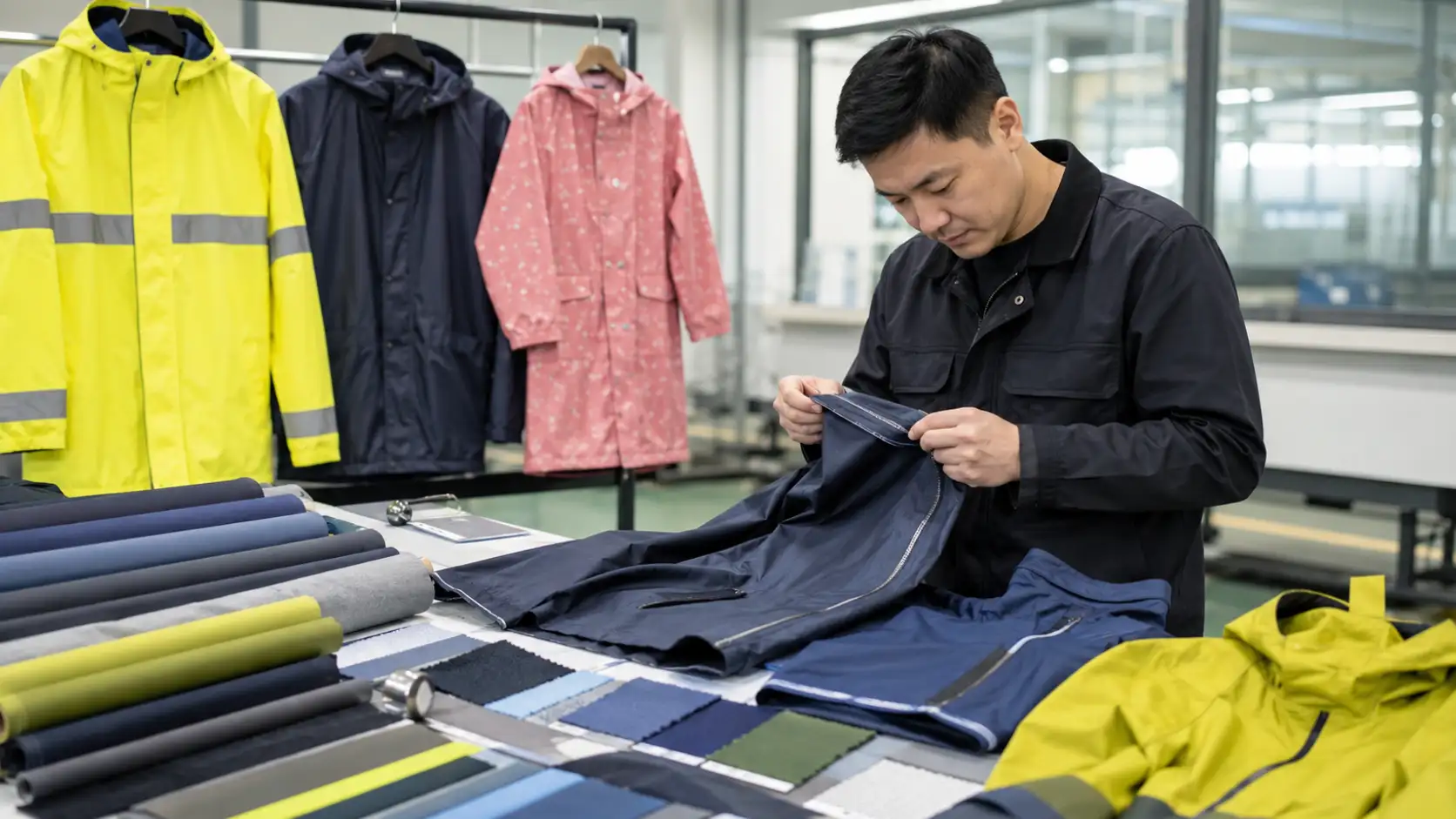
When a Lower Waterproof Rating Makes Sense
A lower waterproof rating can be suitable when the product is used for short periods, light rain, simple events, or budget-sensitive distribution.
For example, a simple event poncho does not need the same rating as a cycling rain jacket. If the buyer over-specifies the poncho, the cost may increase without improving the end user’s real experience.
Lower ratings may make sense for:
Promotional raincoats
Event ponchos
Emergency rainwear
Short-use tourist rainwear
Low-cost giveaway products
The buyer should still check basic quality, odor, thickness, and packaging.
When a Higher Waterproof Rating Makes Sense
A higher waterproof rating makes sense when the user faces longer rain exposure, work conditions, pressure points, wind-driven rain, or outdoor activity.
Higher ratings may be suitable for:
Workwear raincoats
Outdoor rain jackets
Cycling rainwear
Hiking shells
Logistics rainwear
Fishing rainwear
Premium private-label rain jackets
However, higher ratings should be paired with proper seams, zippers, hood design, and breathability. Otherwise, the number becomes a nice specification but not a better product.
When Waterproof Rating Should Not Be the Main Selling Point
In some products, waterproof rating is important but not the main selling point.
For children’s rainwear, safety, softness, odor control, and comfort may be just as important. For promotional raincoats, cost and packaging may matter more. For workwear, durability, visibility, and seam strength may matter more than a single hydrostatic head number.
Buyers should treat waterproof rating as one part of the full product decision.
Why Work With a Professional Rainwear Manufacturer
A professional rainwear manufacturer should not only ask, “What waterproof rating do you want?”
A professional rainwear manufacturer should help buyers define waterproof rating based on product category, target market, fabric structure, seam method, and final garment performance.
A better manufacturer should first understand the product category, target user, rain exposure, market, comfort requirement, material preference, compliance needs, MOQ, logo method, and finished garment construction.
This matters because different products need different waterproof strategies. A school raincoat, workwear rain suit, cycling jacket, event poncho, and premium outdoor shell cannot be developed with the same logic.
CHN Rainwear can help buyers compare waterproof ratings, select suitable materials, prepare samples, evaluate seam construction, and develop custom rainwear for promotional, workwear, school, outdoor, and private-label orders.
For buyers who are unsure whether 3000mm, 5000mm, 8000mm, or 10000mm is the right choice, the best starting point is a product requirement discussion. Once the use scenario is clear, the waterproof rating becomes easier to define.
Final Recommendation: Choose Waterproof Rating by Use, Not by Number
The best waterproof rating is not always the highest number. It is the number that matches the product’s real use, market expectation, garment construction, and cost target.
A 3000mm rating may be enough for short-term rainwear. A 5000mm to 8000mm rating may be suitable for many daily rain jackets and school raincoats. An 8000mm to 10000mm rating may be better for workwear and longer exposure. A 10000mm or higher rating may be needed for outdoor and cycling rainwear. A 20000mm rating may support premium technical products, but it is not necessary for every order.
Buyers should also remember that fabric rating is not finished garment waterproofness. Seam sealing, zipper design, hood coverage, cuff structure, coating quality, and finished sample testing all matter.
For B2B rainwear sourcing, the safest decision is to define the use case first, then choose the waterproof rating. That approach reduces cost waste, avoids product complaints, and helps the final rainwear perform as expected. If buyers are unsure whether 5,000mm, 8,000mm, or 10,000mm is the right level, it is better to test a finished sample than rely only on a specification sheet. CHN Rainwear can help buyers compare waterproof ratings, review garment construction, and prepare samples before bulk production.
Conclusion: Better Rainwear Starts With the Right Waterproof Standard
A reliable rainwear product begins with a clear waterproof standard. Buyers who understand hydrostatic head can compare fabrics more accurately, ask better supplier questions, and avoid vague claims such as “high waterproof” or “good waterproof fabric.”
However, Waterproof Rating should never be treated as the only decision factor. A rainwear product must also have suitable fabric, proper coating, strong seams, protected openings, comfortable design, compliance support, and consistent production control.
For promotional rainwear, do not overpay for technical ratings the user does not need. For daily rain jackets, balance waterproof protection with comfort. For workwear, pay attention to durability and seam strength. For outdoor and cycling rainwear, combine waterproof rating with breathability. For premium technical apparel, use higher ratings only when the product and market justify them.
CHN Rainwear can support buyers with waterproof rating selection, material comparison, sample development, seam construction review, and custom rainwear manufacturing for wholesale, workwear, school, outdoor, promotional, and private-label rainwear projects. For buyers planning a new rainwear order, confirming the right waterproof rating before bulk production is a practical way to reduce leakage complaints, control cost, and build a product that performs in real rain—not just on a specification sheet.
If you are planning a wholesale, workwear, school, outdoor, promotional, or private-label rainwear project, you can contact CHN Rainwear for waterproof rating recommendations before confirming samples or bulk production.
よくあるご質問
1. What does waterproof rating mean in rainwear?
Waterproof rating in rainwear describes how much water pressure a fabric can resist before water begins to penetrate. It is usually measured in millimeters through hydrostatic head testing. For example, a 5000mm waterproof rating means the fabric can resist a certain level of water pressure under controlled test conditions. A higher number generally means stronger water resistance, but buyers should not judge the finished product by fabric rating alone. Rainwear performance also depends on seam sealing, zipper protection, hood design, cuff structure, coating quality, breathability, and finished garment testing. For B2B buyers, waterproof rating is useful for comparing fabrics, but it should always be matched with product use, target market, comfort requirements, and garment construction.
2. What is hydrostatic head?
Hydrostatic head is a test measurement used to evaluate how much water pressure a fabric can withstand before leakage occurs. In a typical test, a fabric sample is placed under controlled water pressure. The pressure gradually increases until water droplets appear through the fabric. The result is recorded in millimeters, such as 3000mm, 5000mm, 10000mm, or higher. Hydrostatic head is commonly used for waterproof fabrics, rainwear materials, outdoor jackets, and protective garments. For rainwear buyers, it provides a measurable way to compare waterproof performance between materials. However, hydrostatic head usually refers to fabric performance, not the complete finished garment. Seams, zippers, pockets, cuffs, hoods, and garment design still affect real rain protection.
3. Is 5000mm waterproof enough for rainwear?
A 5000mm waterproof rating can be enough for many daily rainwear products, including school raincoats, urban rain jackets, commuting rainwear, and moderate rain protection. It is often a practical range for buyers who want a balance between waterproof performance, comfort, cost, and mass production feasibility. However, whether 5000mm is enough depends on the use scenario. For short rain exposure, it may perform well. For heavy rain, long outdoor work, cycling, hiking, or pressure from backpacks, buyers may need higher ratings such as 8000mm, 10000mm, or more. Finished garment construction is also important. A 5000mm fabric with well-sealed seams can perform better than a higher-rated fabric with poor stitching or weak zipper protection.
4. Is 10000mm waterproof rating good?
A 10000mm waterproof rating is generally considered strong for many rainwear applications. It can be suitable for workwear raincoats, outdoor rain jackets, logistics rainwear, cycling rainwear, and longer rain exposure. However, buyers should not choose 10000mm only because the number looks better. The rating should match the product’s real use. For basic promotional ponchos or light school rainwear, 10000mm may be unnecessary and may increase cost. For workwear or outdoor rainwear, it can be valuable when paired with proper seam sealing, durable coating, zipper protection, and good garment design. Breathability should also be considered, especially for active users. A high waterproof rating without comfort control may still lead to poor user experience.
5. What waterproof rating is best for workwear raincoats?
For workwear raincoats, buyers often consider 8000mm to 10000mm or higher, depending on the working environment. Workers may face heavy rain, long exposure, mud, water spray, kneeling, bending, and pressure from tools or equipment. Because of this, waterproof rating should be evaluated together with durability. A good workwear raincoat should also have strong fabric, coating stability, abrasion resistance, seam sealing or welding, zipper protection, reflective tape, hood coverage, and practical cuff design. In many cases, a lower-rated fabric with excellent garment construction may perform better than a higher-rated fabric with weak seams. Buyers should ask the rainwear manufacturer whether the finished garment is tested, not only whether the fabric has a waterproof rating.
6. Why can a rain jacket leak even if the fabric has a high waterproof rating?
A rain jacket can leak even when the fabric has a high waterproof rating because fabric performance and finished garment performance are not the same. Hydrostatic head testing usually measures a flat fabric sample. Once the fabric is cut and sewn into a jacket, leakage can occur through stitched seams, zipper openings, pocket edges, cuffs, hood seams, and poorly sealed construction. Water pressure from sitting, kneeling, backpack straps, or wind-driven rain can also force water into weak points. Coating aging, folding, washing, and abrasion may reduce performance over time. For this reason, B2B buyers should evaluate seam sealing, zipper protection, hood design, finished sample testing, and quality inspection together with the fabric waterproof rating.
7. Should buyers always choose the highest waterproof rating?
No, buyers should not always choose the highest waterproof rating. A higher rating can improve water pressure resistance, but it may also increase material cost, reduce comfort, or be unnecessary for the product’s real use. A promotional poncho does not need the same waterproof rating as a premium outdoor shell. A school raincoat may need moderate waterproofing, softness, safety, and low odor more than a very high hydrostatic head value. A workwear raincoat may need strong waterproofing, but also abrasion resistance and seam strength. The best waterproof rating is the one that matches the product category, wearing time, rain exposure, target market, garment construction, and buyer’s cost target.
References
- A Simple Guide to Hydrostatic Head Testing
Author/Organization: James Heal
Source: James Heal - Resistance to Water Penetration: Hydrostatic Pressure Test According to AATCC 127 / ISO 811
Author/Organization: Centexbel
Source: Centexbel - The Complete Guide to Hydrostatic Head Test
Author/Organization: TESTEX
Source: TESTEX Textile - Waterproof Breathable Textiles Market Size Report, 2030
Author/Organization: Grand View Research
Source: Grand View Research - Waterproof Breathable Textiles Market Size & Share Analysis
Author/Organization: Mordor Intelligence
Source: Mordor Intelligence - France Publishes Updated PFAS Regulation for Consumer Products
Author/Organization: SGS
Source: SGS Safeguards - France – Update on Prohibition of Clothing Textile Products Containing PFAS
Author/Organization: Intertek
Source: Intertek - OEKO-TEX Standard 100: Product Class and Textile Safety Criteria
Author/Organization: OEKO-TEX Association
Source: OEKO-TEX
Waterproof Rating Insights for Smarter Rainwear Procurement
What does Waterproof Rating really mean for rainwear buyers? Waterproof Rating explains how much water pressure a fabric can resist before water penetrates the material. It is commonly measured by hydrostatic head testing and expressed in millimeters, such as 3,000mm, 5,000mm, 8,000mm, 10,000mm, or 20,000mm. For B2B rainwear procurement, this number helps compare waterproof fabrics, but it should not be treated as the only proof of finished garment performance.
Why is hydrostatic head important but not enough? Hydrostatic head measures fabric performance under controlled test conditions. A fabric may achieve a strong rating in the lab, but finished rainwear can still leak through stitched seams, zipper openings, pockets, cuffs, hood seams, pressure points, or weak coating areas. Buyers should evaluate the waterproof rating together with seam sealing, garment construction, zipper protection, coating durability, and finished sample testing.
How should buyers choose the right waterproof rating? The right rating depends on the final product scenario. Short-use promotional raincoats and event ponchos may only need basic waterproof protection. School raincoats and urban rain jackets often need a balance between waterproofness, comfort, softness, and cost. Workwear raincoats usually require stronger ratings, durable coatings, seam strength, and abrasion resistance. Outdoor and cycling rainwear should combine higher waterproof ratings with breathability and better garment engineering.
Which waterproof rating range fits different rainwear products? For simple rain ponchos, 1,500–3,000mm may be enough. For daily rainwear and school raincoats, 3,000–5,000mm or 5,000–8,000mm is often practical. For workwear raincoats and longer rain exposure, 8,000–10,000mm or higher may be more suitable. For cycling, hiking, and premium outdoor shells, 10,000mm–20,000mm+ can be considered, but only when breathability, seam sealing, and product positioning justify the higher specification.
What risks appear when buyers choose the wrong rating? If the waterproof rating is too low, the final rainwear may leak, causing returns, complaints, poor reviews, or customer claims. If the rating is unnecessarily high, buyers may pay for performance the user does not need, increase fabric cost, reduce comfort, or complicate MOQ and lead time. If the fabric rating is correct but seams and openings are poorly designed, the garment may still fail in real rain.
What compliance and market trends should buyers consider? Waterproof rainwear sourcing is shifting from “waterproof only” toward waterproof, wearable, compliant, and durable products. Buyers serving the EU, North America, children’s rainwear, outdoor apparel, and private-label markets should discuss PFAS-free finishing, REACH-related restricted substances, phthalate-free PVC options, OEKO-TEX or GRS materials if required, color fastness, odor control, and long-term coating stability before sampling.
What should buyers ask a rainwear manufacturer before bulk production? Buyers should confirm the waterproof rating, hydrostatic head test method, fabric structure, coating type, seam method, zipper protection, hood design, sample testing process, MOQ, lead time, compliance documents, and quality control procedure. A professional rainwear manufacturer should help buyers select the right rating based on product category, target market, wearing time, comfort needs, and real rain exposure—not simply recommend the highest number.
Practical recommendation: The safest sourcing decision is to define the rainwear application first, then choose the waterproof rating. A 5,000mm fabric may be enough for many daily rain jackets, while workwear and outdoor rainwear may need 8,000–10,000mm or more. Before placing a wholesale rainwear order, buyers should test a finished sample, review seam construction, and confirm whether the rating truly matches real product use. CHN Rainwear can support waterproof rating selection, material comparison, sample development, and custom rainwear manufacturing for promotional, workwear, school, outdoor, and private-label projects.